

If your filling fell out, try not to judge the condition of the tooth by pain alone. Some teeth are sensitive right away, while others cause very little discomfort even though the exposed area still needs to be examined.
Until you can see a dentist, keep the area clean and avoid chewing hard foods on that side. If there is significant pain, swelling, bleeding, or damage to the tooth, describe those symptoms when you call so the urgency can be assessed.
The repair itself depends on what remains underneath the old filling. A dentist will look at how much healthy tooth structure is left, whether there is decay or a crack, and whether the pulp inside the tooth may be involved.
A new filling may be suitable when enough sound tooth remains to support it. A crown may be considered when the tooth has lost more structure, while root canal treatment may be recommended if examination and testing indicate that the pulp requires treatment.
So when a filling comes out, one of the most useful questions is: can this tooth still support another filling? The answer often determines where the treatment discussion goes next.
What Should I Do If My Filling Fell Out?
Protect the tooth and arrange a dental assessment.
The Canadian Dental Association recommends seeing a dentist as soon as possible after losing a filling. Until then, the goal is to avoid irritating or further damaging the exposed area.
You can:
-
Keep the filling if you find it
-
Gently brush around the area to keep it clean
-
Avoid hard foods on the affected side
-
Be careful with foods or drinks that trigger sensitivity
-
Avoid repeatedly touching the opening with your tongue
-
Avoid placing household glue or adhesive in the tooth
-
Use over-the-counter pain medication only as directed and when it is safe for you
-
Tell the dental office if the filling came out after an injury
-
Mention swelling, bleeding, severe pain, fever, or difficulty opening your mouth when you call
-
Seek medical emergency care if swelling begins to affect breathing or swallowing
Our emergency dentistry guidance also recommends keeping a lost restoration if you can find it and protecting the area from hard foods until it can be assessed.
The CDA notes that softened sugarless chewing gum can be used to cover the opening for a short period. This is temporary protection only and does not repair the tooth.
Why Did My Filling Come Out?
There are several possible reasons.
Finding the cause is useful because replacing the missing material without understanding the condition of the tooth may overlook the problem that caused the restoration to fail.
Possible reasons include:
-
Decay developing around or beneath an existing filling
-
Fracture of the filling material
-
Fracture of the surrounding tooth
-
Wear around the edges of an older restoration
-
Loss of bonding or retention
-
Heavy chewing forces
-
Grinding or clenching
-
Biting an unexpectedly hard object
-
Trauma to the tooth
-
A large restoration leaving less natural tooth structure around it
-
Changes affecting the fit or margins of the restoration
Sometimes the filling comes out largely intact. Sometimes what looks like a broken filling also contains a piece of natural tooth.
That distinction can change the repair.
How Does a Dentist Decide on a Lost Filling Repair?
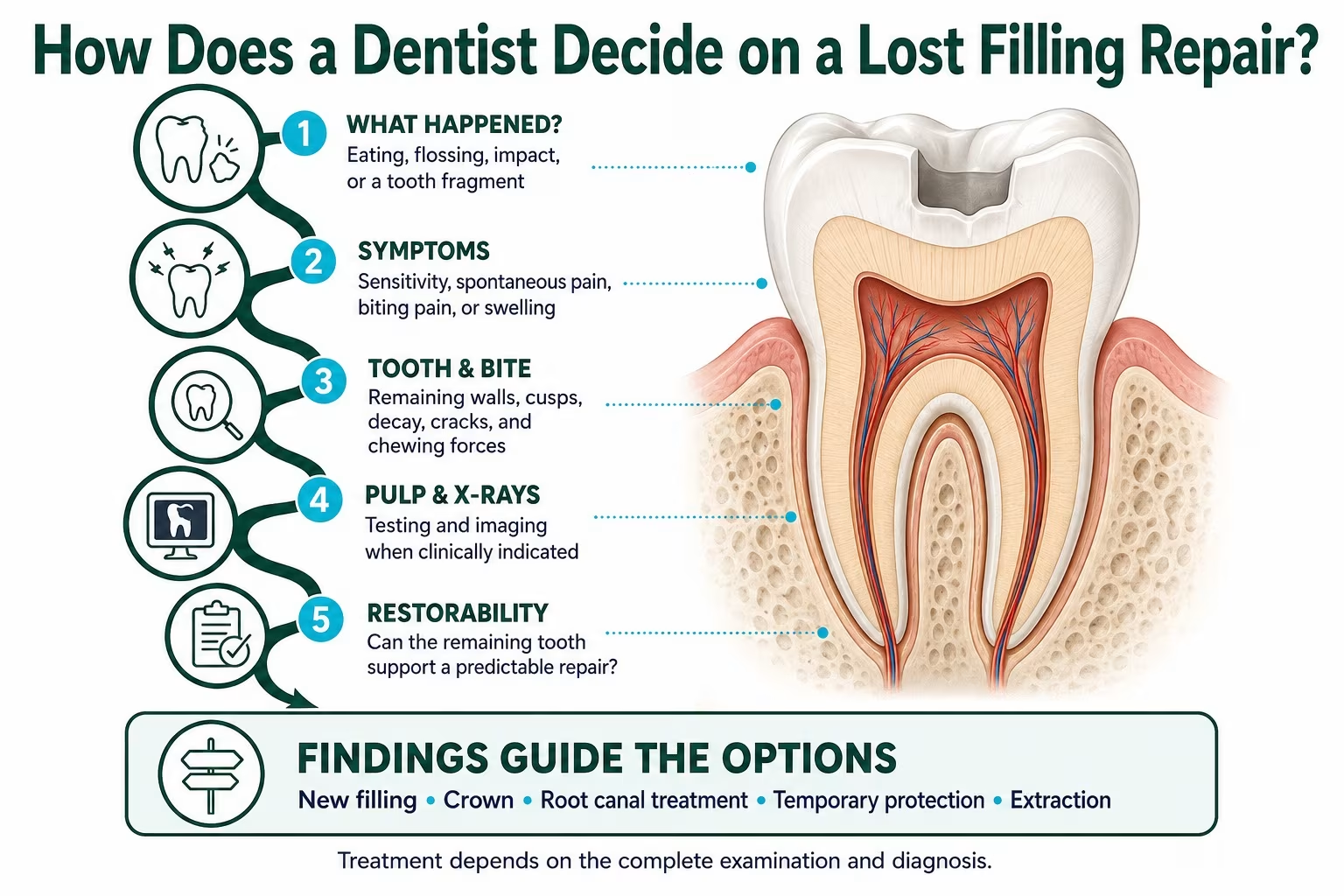
The decision begins with the tooth, rather than the size of the piece that came out.
A dentist may consider your symptoms, dental history, remaining tooth structure, existing restorations, bite, pulp health, and any signs of decay or cracking. Dental X-rays may also be recommended when clinically indicated.
A typical assessment may include:
-
Asking what happened. Was the filling lost while eating, flossing, or after an impact? Did part of the tooth come with it?
-
Reviewing your symptoms. The dentist may ask about temperature sensitivity, spontaneous pain, pain when chewing, swelling, changes in the bite, or symptoms that come and go.
-
Examining the remaining tooth. The dentist looks at the walls and cusps around the old restoration, visible decay, fractures, sharp edges, and how much sound structure appears to remain.
-
Checking the bite when relevant. Pressure on the tooth and the way the upper and lower teeth contact can influence both symptoms and the restorative plan.
-
Assessing the pulp when indicated. Depending on the history and examination, testing may be used to gather information about how the pulp is responding.
-
Taking dental X-rays when needed. Imaging can provide information about decay, roots, previous treatment, supporting tissues, and changes around the root.
-
Considering restorability. The dentist determines whether the remaining tooth can reasonably support a direct filling, needs broader coverage, or requires another treatment first.
-
Discussing the options. Treatment may involve a filling, crown, root canal treatment, temporary protection, another restorative approach, or extraction when a tooth cannot reasonably be restored.
The sequence can vary because different teeth present differently.
When Can a Dentist Replace the Filling?
Often, when enough suitable tooth structure remains.
A direct dental filling may be considered when the damaged area can be restored while leaving adequate surrounding tooth structure and a suitable shape for the restoration.
The dentist may look for factors such as:
-
How much natural tooth remains
-
Whether the remaining walls are adequately supported
-
Whether a cusp has fractured
-
Whether new decay is present
-
How far the damaged area extends
-
Whether the margins can be restored appropriately
-
Where the tooth sits in the mouth
-
How much chewing force the tooth receives
-
Whether the tooth has already been restored several times
-
Whether there are signs suggesting a crack
-
Whether the pulp appears healthy enough for restorative treatment
-
Whether the area can be properly isolated for the planned material
A physically large filling does not automatically mean a crown is required. A small-looking opening does not automatically mean the repair will be small either.
What is visible from the top of the tooth may tell only part of the story.
When Might a Crown Be Better Than Another Filling?
A crown may be considered when the remaining tooth needs broader coverage and protection.
The Canadian Dental Association lists crowns as an option for damaged teeth and notes that they are commonly used to support large fillings, repair broken teeth, or restore teeth after root canal treatment.
After an old filling fails, a dentist may discuss a dental crown when findings include:
-
Extensive loss of natural tooth structure
-
A large existing restoration
-
One or more weakened cusps
-
A fractured cusp
-
A restorable crack that changes how the tooth needs to be protected
-
Repeated restoration failure
-
A tooth that has undergone root canal treatment
-
Bite forces that place substantial stress on the remaining structure
-
A shape that makes another direct filling less suitable
-
The need for coverage beyond the area a filling would occupy
This is where the question “replace filling or crown?” becomes more useful than simply asking whether another filling can physically be placed.
A filling occupies the missing portion of a tooth. A crown covers the prepared visible portion more extensively. The dentist chooses between them based on the condition of the tooth and the requirements of the restoration.
Can a Filling Falling Out Mean I Need a Root Canal?
Yes, but losing a filling by itself does not mean root canal treatment is required.
Root canal treatment is used when the dental pulp becomes inflamed or infected to a degree that requires endodontic treatment. Deep decay, cracks, trauma, and repeated procedures on a tooth are among the factors that can affect the pulp.
A dentist may pay closer attention to symptoms such as:
-
Spontaneous tooth pain
-
Lingering response to hot or cold
-
Significant pain when biting
-
Pain that wakes you from sleep
-
Swelling around the tooth
-
A gum swelling or drainage near the tooth
-
A history of deep decay
-
A recent fracture
-
Changes found during pulp testing
-
Changes around the root seen on an appropriate dental X-ray
These findings still do not diagnose the problem on their own.
The pulp and tissues around the root need to be assessed together before deciding whether endodontic treatment is appropriate.
Pain improving also does not prove that the underlying problem has resolved. Our emergency guidance specifically advises against delaying assessment simply because dental pain temporarily improves.
How Do a New Filling, Crown, and Root Canal Compare?
They solve different problems.
|
Option |
What it addresses |
When it may enter the discussion |
What still has to be assessed |
|
New filling |
Replaces tooth structure lost through decay or damage |
Enough suitable tooth remains for a direct restoration |
Decay, remaining walls and cusps, bite, pulp findings |
|
Crown |
Covers and protects a more extensively prepared tooth |
The tooth is weakened, extensively restored, cracked, or needs broader coverage |
Restorability, remaining sound structure, crack extent, bite |
|
Root canal treatment |
Treats diseased or infected pulp inside the tooth |
Pulpal and periapical findings indicate endodontic treatment |
Pulp diagnosis, root condition, restorability, final restoration |
|
Temporary restoration |
Protects the area for a limited period |
Definitive treatment cannot or should not be completed immediately |
Reason for temporization and follow-up plan |
|
Extraction |
Removes the tooth |
The tooth cannot reasonably be restored or removal is otherwise clinically appropriate |
Restorability, periodontal support, alternatives and patient preferences |
A root canal and a crown are also not competing treatments in the same way as a filling and crown.
A tooth may need root canal treatment and a final restoration. Depending on the tooth and remaining structure, that restoration may be a filling or crown. The CDA notes that restoration after root canal treatment depends on the amount of damage and the tooth involved.
Where Can I Get Lost Filling Repair in Guelph?
If a restoration has come out, we can assess the tooth and explain which repair options are appropriate based on what we find.
Our Guelph clinic provides emergency dentistry, dental fillings, crowns, root canal treatment, and other restorative services. We are open seven days a week, including evening hours, and same-day appointments may be available depending on urgency and scheduling.
If you are in significant pain or have swelling, call and describe your symptoms. For a less urgent concern, you can also book an appointment online.
Wellington Dental Clinic
86 Gordon St Unit-D
Guelph, ON N1H 4H6
Canada
Phone: (226) 314-3614
Email: smile@wellingtondentalguelph.ca
What Else Do Patients Ask When a Filling Fell Out?
Can I leave a lost filling until my next regular checkup?
It is better to contact a dentist rather than deciding based only on pain. The CDA recommends seeing a dentist as soon as possible after a lost filling. How quickly you need to be seen depends on the condition of the tooth and your symptoms.
Should I keep the filling if I find it?
Yes. Keep the restoration and bring it with you if possible. It can also be useful to tell the dentist whether you noticed any tooth-coloured material or tooth fragment attached to it.
Can I put the old filling back in myself?
Do not use household glue or attempt a permanent repair yourself. The exposed area should be assessed first because decay, fracture, or another problem may be present underneath. Our emergency guidance specifically advises against household glue for lost restorations.
Why does my tooth hurt when cold air or water touches it?
Exposed tooth structure can sometimes become sensitive after a restoration is lost. Temperature sensitivity can also occur for other reasons, including cracks or pulpal irritation. The pattern and duration of the sensitivity can provide useful information, but a dental examination is needed to determine the cause.
Why does it hurt only when I bite?
Pain with chewing can have several possible causes. A damaged restoration, fractured cusp, crack, inflammation around the tooth, or another dental problem may produce biting discomfort. Cracked-tooth symptoms can sometimes occur during biting or when pressure is released.
Will I definitely need a crown if the old filling was large?
No. The size of the previous filling is one consideration. The dentist also evaluates remaining tooth structure, decay, cracks, the condition of the cusps, bite forces, pulp findings, and the location of the tooth.
Some large restorations can be managed differently depending on the individual tooth.
Will I need root canal treatment because my filling fell out?
Not necessarily. Root canal treatment is considered when findings indicate disease or infection involving the dental pulp. Losing a restoration alone does not establish that diagnosis.
Ready to Have the Tooth Checked?
If your filling fell out, contact us so we can assess the remaining tooth and determine what type of repair is appropriate. Call (226) 314-3614 or use our online booking system for appointment availability.
Wellington Dental Clinic
86 Gordon St Unit-D
Guelph, ON N1H 4H6
Canada
Phone: (226) 314-3614
Email: smile@wellingtondentalguelph.ca
This article provides general educational information and is not a diagnosis or a replacement for advice from a dentist, physician, or other qualified health professional. Treatment recommendations depend on an individual examination and diagnosis. Seek emergency medical care for difficulty breathing or swallowing, rapidly spreading facial or neck swelling, uncontrolled bleeding, or other life-threatening symptoms.