
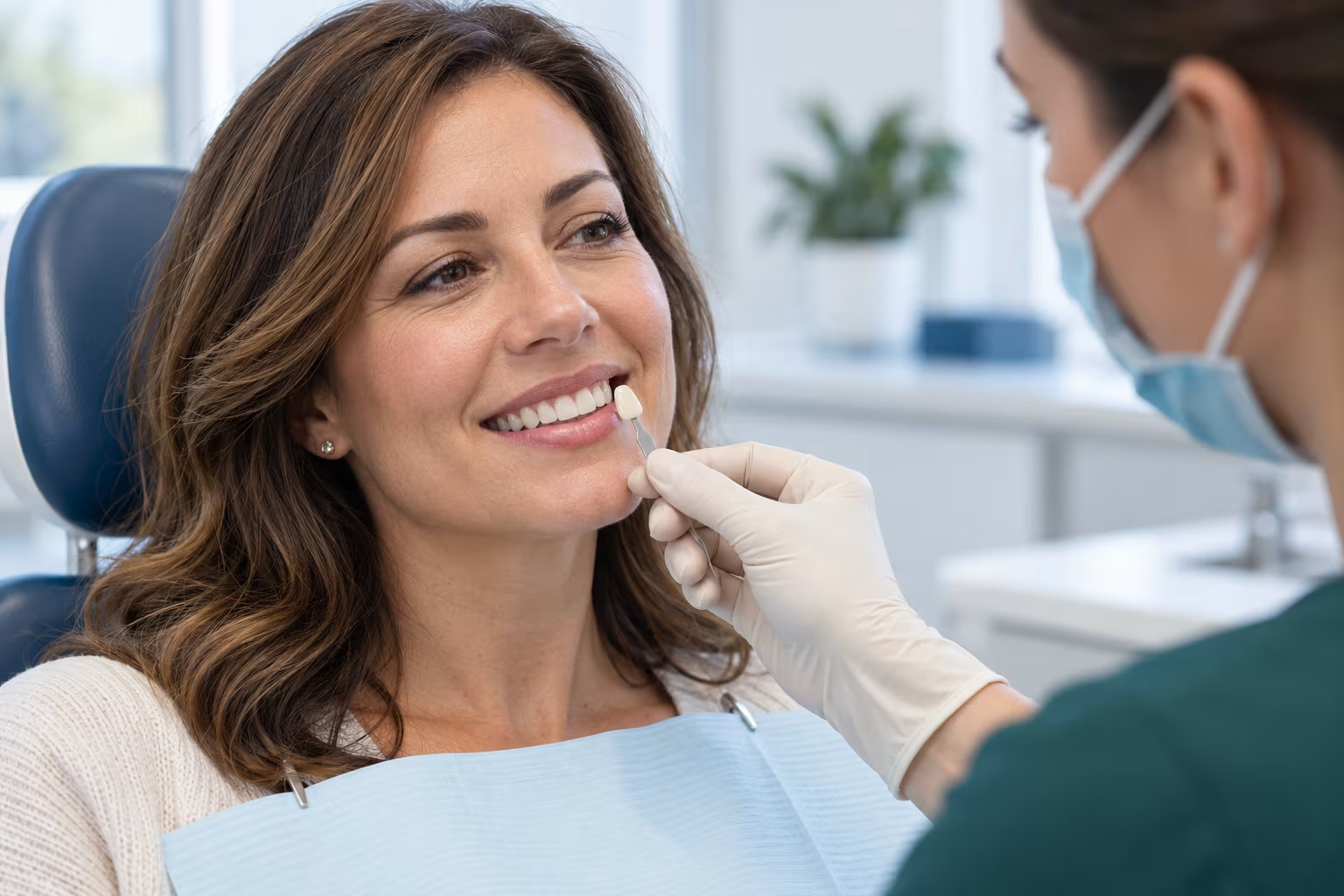
Whitening can lighten most of a smile and still leave one tooth, band, or patch looking noticeably different. When teeth stains are not whitening evenly, the reason may be the type and location of the discolouration rather than the strength of the whitening product.
Extrinsic staining on the enamel surface, intrinsic tooth stains within enamel or dentin, and the shade of an existing filling, crown, or veneer do not behave the same way during bleaching. Whitening can change the colour of natural tooth structure, while existing tooth-coloured restorations generally retain their original shade.
Repeating the whitening will not close that colour gap if the tooth in question is a crown. A dentist may need to establish what is creating the colour difference, whether the affected area is natural tooth or restorative material, and whether whitening is likely to change it further.
Depending on those findings, the discussion may stay with whitening or move toward options such as bonding or veneers.
Why Are Some Teeth Stains Not Whitening Evenly?
Because tooth discolouration does not all come from the same place.
Dentists generally describe discolouration as extrinsic, intrinsic, or a combination of both.
Extrinsic staining develops on the outside of the tooth. Common contributors include:
- Coffee
- Tea
- Red wine
- Darkly pigmented foods
- Tobacco
- Some metal exposure
- Plaque and surface deposits
- Some oral rinses or medications
Some surface stains can be reduced through brushing, whitening toothpastes, or professional cleaning depending on their cause. Peroxide whitening may then change the underlying natural tooth colour.
Intrinsic discolouration occurs within enamel or dentin.
Possible causes include:
- Changes associated with ageing
- Dental fluorosis
- Tetracycline exposure while teeth were developing
- Changes involving the dental pulp
- Previous trauma
- Decay
- Some dental materials
- Developmental or genetic dental conditions
The response to whitening can vary considerably among these causes.
What Are Intrinsic Tooth Stains?
They are colour changes located within the tooth rather than deposits sitting mainly on its surface.
Whitening agents such as hydrogen peroxide can enter dental hard tissues and alter some of the coloured compounds within enamel and dentin. This is why some intrinsic tooth stains can respond to bleaching.
The word “intrinsic” does not mean “cannot be whitened.”
It also does not tell a dentist how much change to expect.
Two people with internal discolouration can respond differently because the origin, colour, depth, distribution, tooth structure, and previous treatment are different.
That distinction becomes useful when someone has already tried whitening and assumes the only next step is a stronger product.
Why Is Whitening Not Working on a Crown, Veneer, or Filling?
Because bleaching changes natural tooth structure, rather than the colour of an existing tooth-coloured restoration.
Crowns, veneers, composite fillings, bonding, and implant crowns do not lighten along with neighbouring natural teeth.
This can create several patterns:
- A crown that matched before whitening appears darker afterward
- Bonding on a front tooth stays the original shade
- A tooth-coloured filling becomes easier to see
- Natural teeth lighten while veneers remain unchanged
- Different restorations become more obvious as the surrounding enamel changes
More whitening does not change the colour of the restoration.
If a visible restoration no longer matches after whitening, replacement may be discussed when the colour difference is significant enough to bother the patient and replacement is otherwise reasonable.
Replacing sound dental work solely for colour is still a treatment decision. The condition of the restoration, amount of tooth involved, expected benefit, cost, and patient preference should be considered before proceeding.
Can Whitening Make White Spots Look More Noticeable?
It can change the contrast between a white area and the surrounding tooth.
White areas can have several possible causes, so appearance alone should not be used to identify them.
The ADA notes that some white staining associated with fluorosis or previous orthodontic treatment may appear less noticeable as the surrounding tooth lightens. The response is different from the response seen with some brown intrinsic stains.
Early in a whitening process, however, colour differences can sometimes be visually distracting to the patient.
Before treating a white patch as a cosmetic stain, a dentist may need to determine whether the change represents:
- Fluorosis
- A developmental enamel difference
- Demineralization
- A previous dental condition
- Another enamel alteration
Treatment options depend on what the area represents and how extensive it is.
Does Fluorosis Respond to Whitening?
Sometimes.
Dental fluorosis can produce different appearances, including white or brown changes in enamel. Those appearances do not all respond to bleaching in the same way.
The ADA notes that brown fluorosis staining may respond to bleaching, while white fluorosis changes may behave differently as the surrounding tooth colour changes.
This is why describing fluorosis as simply “whitening resistant” can be misleading.
Depending on the appearance and severity, a dentist may discuss:
- Monitoring
- Professional whitening
- Enamel microabrasion in suitable cases
- Resin-based treatment in suitable cases
- Bonding
- Veneers
- Another cosmetic approach
The least invasive reasonable option depends on the individual tooth.
Can Tetracycline Staining Be Whitened?
It may respond, but response varies.
Tetracycline can become incorporated into developing dental tissues and produce intrinsic discolouration. The resulting colour can range in appearance and may include bands across the teeth.
The ADA notes that some tetracycline staining can be diminished with bleaching, although the type of stain can influence both the degree of change and the treatment required.
So a patient who has seen limited change from a short course of store-bought whitening should not assume that every professional option has failed.
The reverse is also true. Whitening cannot be assumed to produce a uniform result in every tetracycline-stained tooth.
The starting colour, banding pattern, desired shade, sensitivity, previous whitening, and willingness to pursue further treatment can all influence the discussion.
What If Only One Tooth Is Darker?
Have the tooth assessed before concentrating whitening products on it.
A single discoloured tooth is different from a generally darker smile.
Possible causes of single-tooth discolouration include previous trauma, dental materials, pulpal changes, resorption, developmental conditions, and other dental findings. Clinical and radiographic assessment can help determine the cause before cosmetic treatment is selected.
A dark tooth should not be assumed to have a dead nerve based on colour alone.
Tell your dentist if the tooth:
- Was injured in the past
- Has had root canal treatment
- Has a large restoration
- Changed colour recently
- Is becoming progressively darker
- Hurts when biting
- Has new temperature sensitivity
- Has swelling nearby
- Feels different from neighbouring teeth
If the tooth has already undergone root canal treatment and is otherwise suitable, internal bleaching may be considered in some cases. Internal bleaching is a different procedure from applying whitening gel to the outside of all the teeth.
The tooth needs to be assessed before that option is considered.
When Should I Stop Repeating Whitening?
When the result is uneven, symptoms are developing, or you do not know what is causing the colour difference.
Repeated whitening is unlikely to correct a crown, veneer, or filling that remains darker than the surrounding natural teeth.
An assessment is also reasonable when you notice:
- One tooth staying much darker
- A distinct band that changes very little
- White patches becoming more noticeable
- A restoration no longer matching
- Significant tooth sensitivity
- Gum irritation
- A recent change in the colour of one tooth
- A history of trauma to the affected tooth
- Pain or swelling
- Uncertainty about whether an area is stain, decay, or restorative material
Temporary tooth sensitivity and gum irritation are recognized adverse effects of vital tooth whitening. Sensitivity can occur with over-the-counter, dentist-dispensed, and in-office bleaching.
If symptoms are significant or persist, stop self-directed whitening and speak with a dentist.
What Does a Dentist Check When Whitening Is Not Working?
The assessment starts by identifying what is being treated.
A clinical examination before bleaching can help identify factors contributing to tooth discolouration. The ADA also recommends considering health and dental history, the patient's understanding of the colour change, allergies, existing restorations, and previous or current tooth sensitivity. Radiographs or other diagnostic tests may be appropriate in selected cases.
Depending on the concern, a whitening assessment may consider:
- Which teeth are affected. A single dark tooth raises different questions from generalized yellowing.
- How the colour is distributed. The dentist may look for surface stain, diffuse internal colour, bands, spots, or a clear boundary around a restoration.
- Whether the visible area is natural tooth. Fillings, crowns, veneers, and bonding need to be identified before predicting how whitening may affect the smile.
- Previous dental treatment. Trauma, root canal treatment, large restorations, orthodontic treatment, or previous cosmetic work can provide useful context.
- The condition of the teeth and gums. Existing dental disease may need assessment or treatment before elective cosmetic procedures.
- Previous whitening. The product used, how it was used, sensitivity, and the pattern of colour change can help guide the next discussion.
- Your starting shade and goal. Natural tooth colour varies, and a requested shade may not be achievable or appropriate with whitening alone.
- Whether another treatment would require less repeated bleaching. Depending on the diagnosis, bonding, a veneer, or another conservative cosmetic treatment may be considered.
Dentist review required: confirm which of these steps are routinely documented during Wellington's own pre-whitening consultations before presenting them as a clinic-specific protocol.
Whitening or Bonding: How Is the Choice Made?
It depends on what is creating the colour difference and how much of the tooth needs to be changed.
Dental bonding uses tooth-coloured composite resin that can be applied to a tooth and shaped to change its appearance. The Canadian Dental Association specifically lists covering a stained tooth so it matches neighbouring teeth as one use for bonding.
Whitening or bonding may be discussed when:
|
Finding |
Whitening may be considered when |
Bonding may be discussed when |
|
General natural tooth darkening |
The colour is within natural tooth structure and likely to respond |
Usually not the first choice solely to lighten many healthy teeth |
|
One localized colour difference |
The tooth is suitable for bleaching |
A limited area needs masking or reshaping |
|
Existing composite |
Surrounding natural teeth are being lightened |
Composite itself needs repair or colour replacement |
|
Intrinsic discolouration |
Bleaching may reasonably improve the shade |
Whitening leaves a localized colour difference the patient still wants addressed |
|
Shape and colour concern together |
Whitening addresses colour only |
Composite may change both colour and contour |
Bonding also introduces restorative material that can later require maintenance, polishing, repair, or replacement.
The presence of a cosmetic concern does not automatically mean covering the tooth is preferable to whitening it.
Whitening or Veneers: When Might Veneers Be Discussed?
Usually when changing the surface appearance of the tooth offers an advantage that whitening cannot provide.
Veneers are thin restorations attached to the front surface of teeth. They can alter colour as well as shape and other visible features.
A whitening or veneers discussion may come up when:
- Discolouration remains unacceptable after reasonable conservative options
- A tooth has colour and shape concerns together
- Multiple front teeth have cosmetic differences the patient wants assessed
- Existing enamel and tooth structure are suitable for veneer treatment
- Expectations cannot reasonably be met with whitening alone
Veneers should not be treated as a stronger form of whitening.
They are restorations.
The CDA notes that veneer treatment may require removal of enamel and is not suitable for every tooth. Active decay or periodontal disease should be treated first, little remaining enamel can affect suitability, and grinding or clenching can influence the risk of damage.
That creates a different commitment from bleaching natural teeth.
Which Option Fits Different Types of Discolouration?
There is no universal sequence.
A useful starting framework looks like this:
|
What the dentist finds |
What may be considered |
|
Surface staining |
Professional cleaning, oral hygiene measures, whitening where appropriate |
|
Generalized natural tooth darkening |
Professional whitening or dentist-supervised take-home whitening |
|
Intrinsic staining |
Whitening may still be considered, depending on the cause and expected response |
|
Tetracycline-related colour |
Individual whitening assessment, with other cosmetic options discussed if needed |
|
Fluorosis-related changes |
Treatment based on colour, distribution, enamel appearance, and severity |
|
Existing crown, filling, bonding, or veneer |
Whitening will not change the restoration's shade |
|
Single dark natural tooth |
Diagnostic assessment before cosmetic treatment |
|
Discoloured root canal-treated tooth |
Internal bleaching may be considered in suitable cases |
|
Localized colour difference that cannot be adequately changed by whitening |
Bonding may be discussed |
|
Wider colour and shape changes |
Veneers may be discussed in suitable teeth |
The table is a treatment-planning guide, rather than a diagnosis.
An examination is still needed to establish what is causing the appearance.
Should I Whiten Before Getting Bonding or Veneers?
Sometimes, especially when surrounding natural teeth are also being lightened.
Composite resin and porcelain restorations are selected to work with the colour of the surrounding smile. Once restorations have been placed, external whitening will not lighten them along with the natural teeth.
That can affect treatment sequencing.
For example, a patient considering bonding on one front tooth may first discuss whether they want their surrounding natural teeth any lighter. The dentist can then plan the restorative shade with the intended overall colour in mind.
The appropriate order varies with the treatment plan.
Do not delay necessary dental treatment solely to whiten your teeth. Whitening is elective, while decay, infection, fractured restorations, and other oral health concerns may need treatment first.
What Can I Expect From Professional Teeth Whitening in Guelph?
The first goal is to determine whether whitening suits the colour change you want to address.
Our teeth whitening page confirms that the dentist reviews available shades with the patient before treatment. The current in-office process uses a professional hydrogen peroxide gel and a specialized light, and individual results can vary.
If whitening is unlikely to address the full concern, we can also assess whether dental bonding, veneers, or another cosmetic dentistry option is reasonable for the teeth involved. Those services are all currently offered at the clinic.
Wellington Dental Clinic
86 Gordon St Unit-D
Guelph, ON N1H 4H6
Canada
Phone: (226) 314-3614
Email: smile@wellingtondentalguelph.ca
FAQs
Why are my teeth stains not whitening even after several attempts?
Several explanations are possible.
The discolouration may be intrinsic, an existing restoration may be creating the darker area, or the stain may respond differently to the whitening method you have used. An examination can help identify which situation applies.
Can intrinsic stains be whitened?
Some can. The ADA notes that whitening can be effective for both extrinsic and intrinsic staining, but response varies with the type of intrinsic colour change.
Why is one tooth darker after whitening?
The surrounding teeth may have lightened more, or the darker tooth may have a different cause of discolouration. A single dark tooth warrants assessment rather than assuming it simply needs more whitening.
Will whitening change the colour of my fillings?
No. Whitening agents affect natural tooth structure. Tooth-coloured restorations do not lighten in the same way.
Can whitening make a crown look darker?
The crown itself does not become darker from whitening. If the surrounding natural teeth become lighter while the crown stays its original shade, the difference may become easier to see.
Does tetracycline staining mean whitening will not work?
No. Some tetracycline-related staining can respond to bleaching, although the degree and pattern of response vary.
Can dental bonding cover a stain that does not whiten?
Bonding can sometimes be used to change the visible colour of a stained tooth. The tooth still needs to be assessed to determine whether bonding is suitable and whether another dental condition should be addressed first.
Are veneers better than whitening for intrinsic stains?
Neither treatment is automatically better.
Whitening preserves natural tooth structure and may improve some intrinsic staining. Veneers are restorations that may be considered when changing the visible tooth surface better matches the treatment goal and the teeth are suitable for them.
Can a root canal-treated tooth be whitened?
Sometimes. For a suitable discoloured tooth that has already undergone endodontic treatment, internal bleaching may be considered after assessment. This is different from conventional external whitening.
Should I keep whitening until every tooth matches?
No. If one area consistently remains different, increasing or repeatedly applying whitening may not address the cause. This is especially relevant when the darker area is a restoration or when one tooth has changed colour independently of the others.
Still Seeing an Uneven Whitening Result?
If teeth stains not whitening evenly are leaving you unsure what to try next, the useful next step is to identify what is producing the colour difference before choosing another cosmetic treatment.
We can assess the teeth and discuss whitening, bonding, veneers, or another option when clinically appropriate. To arrange a cosmetic consultation in Guelph, call (226) 314-3614 or book online. The clinic is currently accepting new patients.
Wellington Dental Clinic
86 Gordon St Unit-D
Guelph, ON N1H 4H6
Canada
Phone: (226) 314-3614
Email: smile@wellingtondentalguelph.ca
This article provides general educational information and is not a diagnosis or a replacement for professional dental or medical advice. The cause of tooth discolouration and suitability for whitening or other cosmetic treatment require individual assessment. Seek emergency medical care for difficulty breathing or swallowing, rapidly spreading facial or neck swelling, uncontrolled bleeding, or other life-threatening symptoms.