
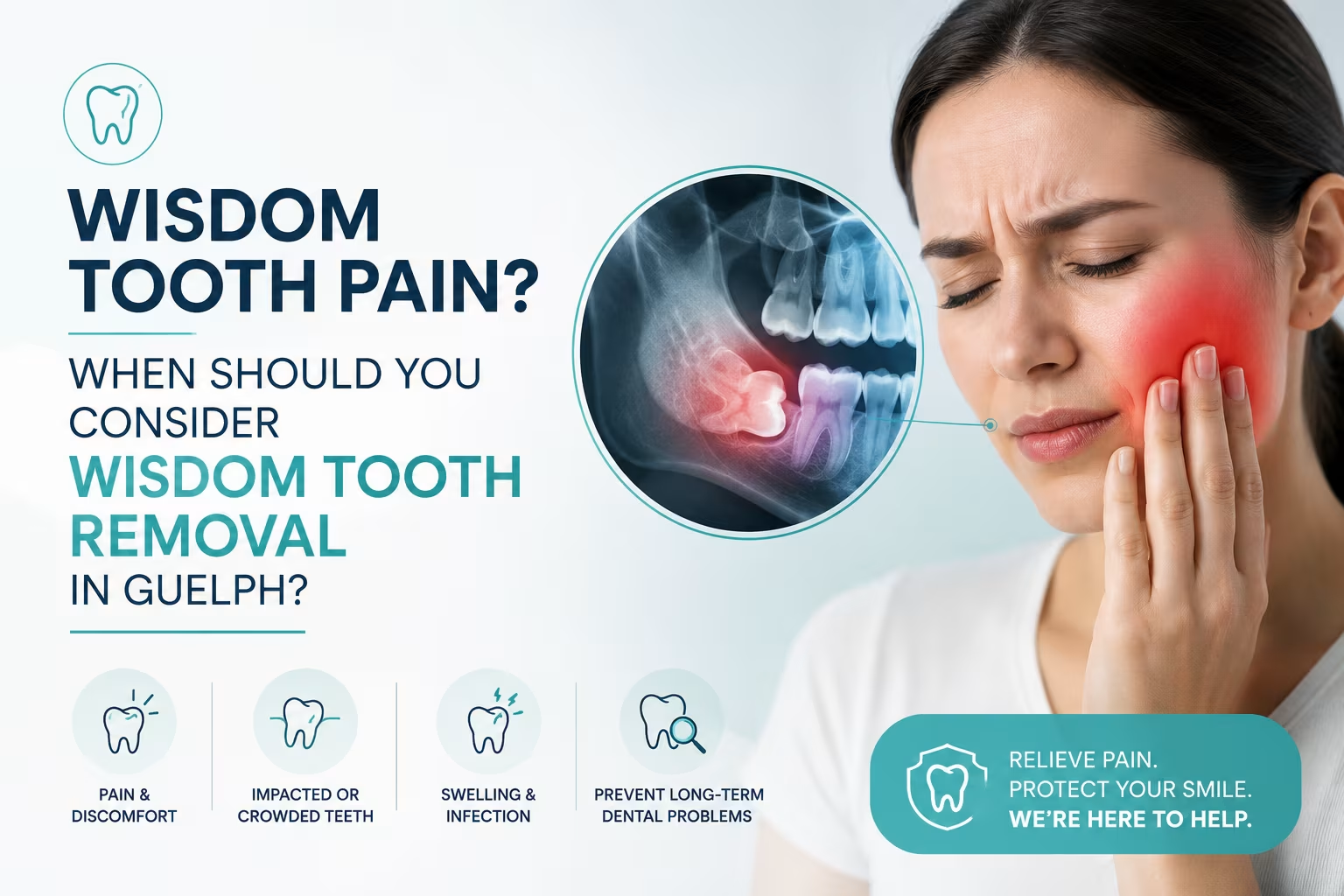
Wisdom teeth can remain unnoticed for years and then suddenly become uncomfortable.
You may feel pressure behind your back molars, notice swollen gums, experience pain when chewing, develop an unpleasant taste in your mouth, or find it difficult to open your jaw comfortably.
When these symptoms appear, a common question is:
“Do my wisdom teeth need to be removed?”
Not every wisdom tooth needs extraction.
Some wisdom teeth erupt normally, remain healthy, can be cleaned effectively, and never cause significant problems. Others become impacted, partially erupt, develop decay, contribute to gum inflammation, or create recurring pain and infection.
If you are experiencing wisdom tooth pain in Guelph, a dental examination can help determine what is happening and whether monitoring, treatment, or wisdom tooth removal should be considered.
What Are Wisdom Teeth?
Wisdom teeth are the third molars located at the very back of the mouth.
They are usually the last permanent teeth to develop and erupt.
Most people can have up to four wisdom teeth:
- Upper right
- Upper left
- Lower right
- Lower left
However, not everyone develops all four wisdom teeth.
Some people develop fewer, while others may not develop wisdom teeth at all.
The presence of wisdom teeth alone is not necessarily a dental problem.
Problems tend to occur when there is insufficient space for them to erupt normally, when they become difficult to clean, or when disease develops around them.
At What Age Do Wisdom Teeth Usually Appear?
Wisdom teeth commonly begin erupting during the late teenage years or early adulthood, although timing varies considerably between individuals.
Some wisdom teeth remain beneath the gums or jawbone and never fully erupt.
Others emerge only partially.
A dentist may use dental X-rays to evaluate:
- Whether wisdom teeth are present
- Their position
- Their angle
- Their stage of development
- Their relationship to neighbouring teeth
- Surrounding bone
- Other nearby anatomical structures
Age alone does not determine whether wisdom teeth need to be removed.
The decision should be based on the individual tooth, symptoms, clinical findings, imaging, and potential risks and benefits of treatment.
Does Everyone Need Their Wisdom Teeth Removed?
No.
Wisdom tooth removal is not automatically required simply because third molars are present.
A wisdom tooth may be monitored if it is:
- Healthy
- Fully erupted
- Functional
- Positioned appropriately
- Free from significant decay
- Surrounded by healthy gum tissue
- Accessible for effective cleaning
- Not damaging neighbouring structures
Regular dental examinations allow your dentist to monitor wisdom teeth over time.
Removal may be considered when a wisdom tooth is causing disease, pain, repeated problems, damage, or other clinically significant concerns.
What Is an Impacted Wisdom Tooth?
A wisdom tooth is described as impacted when it cannot erupt normally into a functional position.
This can happen because:
- There is not enough room in the jaw
- The tooth is angled toward another tooth
- The tooth is angled backward
- Bone prevents normal eruption
- Gum tissue partially covers the tooth
- The tooth develops in an unfavourable position
An impacted wisdom tooth may remain completely beneath the gums or may partially emerge into the mouth.
Some impacted wisdom teeth cause no immediate symptoms.
Others can contribute to pain, infection, decay, gum problems, or damage to nearby structures.
What Does Wisdom Tooth Pain Feel Like?
Wisdom tooth symptoms vary.
You may experience:
- Dull aching behind the last molar
- Pressure at the back of the jaw
- Sharp pain when chewing
- Tender gum tissue
- Pain that comes and goes
- Jaw discomfort
- Swelling around the back tooth
- Difficulty opening your mouth comfortably
- Pain that radiates toward nearby areas
Pain alone does not reveal whether a wisdom tooth needs extraction.
A dental examination is necessary to determine the cause.
Signs Your Wisdom Tooth May Need Dental Attention
Consider arranging a dental assessment if you notice:
- Persistent pain near a wisdom tooth
- Recurring swelling
- Red or tender gums around the tooth
- Difficulty cleaning the area
- Food repeatedly becoming trapped
- Bad taste
- Drainage
- Pain when chewing
- Difficulty opening your mouth
- Repeated infections around a partially erupted tooth
- Decay affecting the wisdom tooth
- Problems involving the neighbouring second molar
You should also seek assessment if a previously symptom-free wisdom tooth begins causing new or worsening discomfort.
Why Do Partially Erupted Wisdom Teeth Cause Problems?
A partially erupted wisdom tooth can create an area where gum tissue overlaps part of the tooth.
This area can be difficult to clean effectively.
Food debris and bacteria may accumulate beneath the gum tissue, potentially contributing to inflammation or infection.
Because the tooth is located at the very back of the mouth, brushing and cleaning around it can also be challenging.
Repeated inflammation around a partially erupted wisdom tooth is one reason a dentist may discuss whether extraction is appropriate.
What Is Pericoronitis?
Pericoronitis is inflammation of the soft tissues surrounding a partially erupted tooth, commonly a lower wisdom tooth.
Symptoms can include:
- Pain around the wisdom tooth
- Swollen gum tissue
- Redness
- Tenderness
- Bad taste
- Difficulty chewing
- Difficulty opening the mouth
- Swelling
Symptoms can range from relatively mild to more significant.
A dentist needs to assess the area to determine appropriate treatment and whether the wisdom tooth itself should be monitored or removed.
Can Wisdom Teeth Become Infected?
Yes.
Infection can develop around a partially erupted wisdom tooth or within the tooth itself.
Possible symptoms include:
- Increasing pain
- Swelling
- Tender gums
- Bad taste
- Drainage
- Difficulty chewing
- Fever
- Difficulty opening the mouth
- Facial swelling
Dental infections should not be ignored.
If swelling becomes severe, rapidly spreads, or interferes with breathing or swallowing, seek emergency medical attention.
Can Wisdom Teeth Develop Cavities?
Yes.
Wisdom teeth can develop tooth decay just like other teeth.
Their location can make them especially difficult to brush and clean.
Decay can develop in:
- The wisdom tooth itself
- The neighbouring second molar
- Areas where food and plaque become trapped
When evaluating a problematic wisdom tooth, your dentist will consider whether the tooth can be predictably cleaned and restored or whether removal may be a more appropriate option.
Can Wisdom Teeth Damage the Tooth Beside Them?
In some cases, an impacted or poorly positioned wisdom tooth may contribute to problems involving the neighbouring second molar.
Potential concerns can include:
- Difficulty cleaning between the teeth
- Tooth decay
- Gum problems
- Localized bone changes
- Other damage associated with the position of the wisdom tooth
Dental imaging can help assess the relationship between the wisdom tooth and adjacent teeth.
Can Wisdom Teeth Cause Jaw Pain?
Wisdom tooth problems can sometimes be associated with discomfort near the back of the jaw.
However, jaw pain has many possible causes, including:
- Teeth grinding
- Clenching
- Temporomandibular joint problems
- Muscle tension
- Dental infection
- Other dental conditions
Do not assume that every episode of jaw pain is caused by wisdom teeth.
A dental examination can help determine the likely source.
Can Wisdom Teeth Cause Headaches?
Patients sometimes associate headaches with wisdom tooth discomfort, but headaches have many possible causes.
Dental pain, jaw muscle tension, clenching, and other oral conditions may contribute to discomfort in nearby areas.
However, recurring headaches should not automatically be attributed to wisdom teeth.
If you experience persistent headaches, appropriate dental or medical evaluation may be needed depending on your symptoms.
Can Wisdom Teeth Cause Ear Pain?
Pain from teeth and surrounding tissues can sometimes be perceived in nearby areas because of shared nerve pathways.
As a result, some dental problems may feel as though discomfort is occurring near the ear.
However, actual ear conditions can produce similar symptoms.
If you have ear pain, especially with hearing changes, discharge, fever, or other ear-related symptoms, medical evaluation may also be appropriate.
How Does a Dentist Check Wisdom Teeth?
A wisdom tooth assessment usually begins with your symptoms and dental history.
Your dentist may ask:
- Where is the pain?
- When did it begin?
- Is it constant or intermittent?
- Have you experienced swelling?
- Is chewing uncomfortable?
- Have you had previous infections?
- Is it difficult to open your mouth?
The dentist will then examine the area.
Dental imaging may be recommended to evaluate the position of the wisdom teeth and surrounding structures.
Why Are Dental X-Rays Important for Wisdom Teeth?
Much of an impacted wisdom tooth may be hidden beneath gum tissue or bone.
Dental X-rays can provide information that cannot be obtained through visual examination alone.
Imaging can help evaluate:
- Tooth position
- Root development
- Degree of impaction
- Available space
- Relationship to adjacent teeth
- Surrounding bone
- Nearby anatomical structures
- Signs of certain dental problems
Your dentist can use this information, together with the clinical examination, to discuss appropriate options.
When Is Wisdom Tooth Removal Recommended?
There is no single rule that applies to every patient.
Wisdom tooth extraction may be considered when there is a clinically significant problem such as:
- Persistent pain
- Recurrent infection or inflammation
- Significant decay
- Gum disease around the tooth
- Damage involving an adjacent tooth
- Certain pathological changes
- A tooth that cannot be predictably restored
- Other problems associated with impaction
The risks and benefits of extraction should be considered for each individual patient.
Can I Keep My Wisdom Teeth?
Yes, when appropriate.
Wisdom teeth that are healthy, functional, and maintainable may not require removal.
If they remain in place, your dentist may recommend ongoing monitoring.
This can include:
- Clinical examinations
- Assessment of gum health
- Monitoring for decay
- Dental imaging when appropriate
- Oral hygiene guidance
The important question is not simply whether you have wisdom teeth.
It is whether those teeth are healthy and can remain healthy.
What Happens During Wisdom Tooth Removal?
The exact procedure depends on the position and complexity of the tooth.
A fully erupted wisdom tooth may sometimes be removed using a relatively straightforward extraction technique.
An impacted tooth may require a surgical approach.
In general, treatment may involve:
1. Dental Assessment
Your dentist reviews your medical history, medications, dental findings, and relevant imaging.
2. Anaesthesia
Local anaesthetic is commonly used to numb the treatment area.
Additional sedation options may be considered in appropriate cases depending on the patient, procedure, clinic capabilities, and clinical assessment.
3. Accessing the Tooth
For an impacted wisdom tooth, gum tissue may need to be carefully opened.
In some situations, a small amount of surrounding bone may need to be managed to access the tooth.
4. Removing the Tooth
Depending on its position, the tooth may be removed in one piece or divided into smaller sections.
5. Cleaning the Area
The extraction site is inspected and cleaned as appropriate.
6. Closing the Site
Stitches may sometimes be placed.
Not every extraction requires sutures.
7. Recovery Instructions
You will receive instructions explaining how to care for the extraction site after treatment.
Does Wisdom Tooth Removal Hurt?
Local anaesthesia is used to reduce pain during the procedure.
You may still experience pressure or movement even when the area is adequately numb.
After the anaesthetic wears off, some discomfort, swelling, and tenderness are common during recovery.
The amount varies depending on:
- Complexity of the extraction
- Number of teeth removed
- Position of the teeth
- Individual healing
- Other patient-specific factors
Follow the post-operative instructions provided by your dental professional.
Can I Be Sedated for Wisdom Tooth Removal?
Sedation may be an option for some patients and procedures.
It can be particularly useful to discuss if you experience significant dental anxiety or are undergoing a more involved procedure.
However, sedation is not appropriate for everyone.
Your dentist needs to review factors including:
- Medical history
- Current medications
- Allergies
- Procedure complexity
- Anxiety level
- Other relevant health considerations
If sedation is used, specific preparation and transportation instructions may apply.
How Long Does Wisdom Tooth Removal Take?
Procedure time varies.
A straightforward extraction of an erupted wisdom tooth may be relatively quick.
Multiple impacted wisdom teeth or teeth in more complex positions can require more time.
Your dentist can provide a more meaningful estimate after reviewing your examination and dental imaging.
What Happens After Wisdom Tooth Extraction?
After the tooth is removed, a blood clot forms in the socket.
This clot is an important part of normal healing.
During the first few days, you may experience:
- Mild to moderate discomfort
- Swelling
- Jaw stiffness
- Tenderness
- Minor oozing or bleeding
- Difficulty chewing firmer foods
Your dentist will provide specific instructions based on your procedure.
How Long Does Wisdom Tooth Recovery Take?
Recovery varies from person to person.
Many patients experience the greatest swelling and discomfort during the early part of recovery, followed by gradual improvement.
The extraction site itself continues healing for longer than the period during which you feel sore.
Factors affecting recovery can include:
- Surgical complexity
- Number of teeth removed
- Tooth position
- Age
- Smoking or vaping
- General health
- Oral hygiene
- Following post-operative instructions
Your dentist can give you individualized guidance about returning to work, school, exercise, and normal eating.
What Can I Eat After Wisdom Tooth Removal?
Immediately after extraction, softer foods are generally easier to manage.
Depending on your dentist's instructions, examples may include:
- Yogurt
- Applesauce
- Smooth soups that are not hot
- Mashed potatoes
- Eggs
- Soft pasta
- Oatmeal after it has cooled appropriately
- Other soft foods that require minimal chewing
Gradually return to your normal diet as healing progresses and comfort allows.
Avoid foods that could easily irritate or become trapped in the extraction area during early healing.
Follow the instructions given by your dental professional.
What Should I Avoid After Wisdom Tooth Removal?
Your post-operative instructions should take priority.
In general, patients may be advised to avoid activities that could disturb the blood clot or irritate the extraction site.
This can include:
- Smoking
- Vaping
- Forceful spitting
- Aggressive rinsing immediately after extraction
- Drinking through straws during the early healing period
- Hard or sharp foods
- Picking at the extraction site
- Strenuous activity immediately after surgery when advised against it
Follow your dentist's instructions regarding brushing, rinsing, eating, and physical activity.
What Is Dry Socket?
Dry socket, also known as alveolar osteitis, is a painful complication that can occur after a tooth extraction.
It develops when the protective blood clot within the extraction site is lost or breaks down before adequate healing has occurred.
Symptoms may include:
- Significant pain that develops or worsens after extraction
- Pain that may radiate toward nearby areas
- An unpleasant taste or odour
- An extraction site that does not appear to be healing normally
If pain becomes significantly worse after initially improving, contact your dental provider.
Dry socket can be treated by a dental professional.
How Can I Reduce the Risk of Dry Socket?
Follow your dentist's post-operative instructions carefully.
Recommendations may include avoiding:
- Smoking
- Vaping
- Straws
- Forceful rinsing
- Disturbing the extraction site
Smoking is particularly important to discuss with your dental provider because it can interfere with normal healing.
Is Swelling Normal After Wisdom Tooth Removal?
Some swelling is expected after many wisdom tooth extractions, particularly surgical procedures.
Swelling may increase during the early recovery period before gradually improving.
Your dentist may provide instructions for managing expected swelling.
However, contact your dental provider if swelling is:
- Severe
- Increasing unexpectedly
- Accompanied by worsening pain
- Associated with fever
- Associated with drainage or other concerning symptoms
Seek emergency medical attention if swelling affects your ability to breathe or swallow.
How Do I Know If My Wisdom Tooth Extraction Is Infected?
Some discomfort and swelling are normal after surgery, so symptoms must be considered in context.
Possible warning signs that should prompt you to contact your dental provider include:
- Worsening rather than improving pain
- Increasing swelling
- Fever
- Pus or unusual drainage
- Persistent bad taste
- Significant difficulty opening the mouth
- Other symptoms your dentist has told you to watch for
Do not attempt to diagnose or treat a post-operative infection yourself.
When Should I Call My Dentist After Wisdom Tooth Removal?
Contact your dental provider if you experience concerning symptoms such as:
- Persistent heavy bleeding
- Severe or worsening pain
- Unexpectedly increasing swelling
- Fever
- Signs of infection
- Persistent numbness or altered sensation
- Difficulty swallowing
- Other symptoms that concern you
For difficulty breathing, rapidly spreading swelling, uncontrolled bleeding, or another potentially life-threatening problem, seek emergency medical attention.
Can I Go to Work After Wisdom Tooth Removal?
It depends on the complexity of your extraction, your occupation, the number of teeth removed, whether sedation was used, and how you feel afterward.
Some people return to routine activities relatively quickly after a straightforward extraction.
Others need more recovery time after surgical removal.
If your work involves strenuous physical activity, your dentist may recommend temporarily limiting certain activities.
Ask about recovery expectations before scheduling your procedure if you need to plan around work or school.
Can I Drive After Wisdom Tooth Removal?
This depends largely on the type of anaesthesia or sedation used.
If you receive local anaesthetic alone, instructions may differ from those for a patient receiving sedation.
Certain forms of sedation require a responsible adult to drive you home and may restrict driving or other activities for a period afterward.
Always follow the specific instructions provided by your dental team.
Should All Four Wisdom Teeth Be Removed at Once?
Not necessarily.
The number of wisdom teeth recommended for removal depends on your individual clinical situation.
Factors can include:
- Which teeth are problematic
- Their position
- Current disease
- Future risks
- Surgical complexity
- Your overall health
- Your dentist's assessment
Some patients may have one wisdom tooth removed, while others may have multiple teeth treated during the same appointment.
The decision should be individualized.
What Happens If I Don't Remove a Problematic Wisdom Tooth?
The outcome depends on the specific problem.
A wisdom tooth that is currently healthy may remain stable and simply require monitoring.
However, a tooth already affected by recurrent infection, significant decay, periodontal problems, or damage to neighbouring structures may continue causing problems if the underlying issue is not addressed.
Your dentist can explain the potential benefits and risks of both treatment and continued monitoring.
Is Wisdom Tooth Pain an Emergency?
Sometimes.
Mild discomfort may be suitable for a regular dental appointment.
Prompt dental assessment is more important when wisdom tooth pain is accompanied by:
- Significant swelling
- Increasing pain
- Fever
- Drainage
- Difficulty opening the mouth
- Suspected infection
- Significant difficulty eating
If swelling interferes with breathing or swallowing or rapidly spreads through the face or neck, seek emergency medical attention.
How Much Does Wisdom Tooth Removal Cost in Guelph?
The cost of wisdom tooth extraction can vary because not every extraction is equally complex.
Factors affecting fees can include:
- Number of wisdom teeth being removed
- Whether teeth are erupted or impacted
- Surgical complexity
- Diagnostic imaging required
- Type of anaesthesia or sedation
- Other treatment considerations
A dental examination is usually necessary before an accurate treatment estimate can be provided.
If you have private dental insurance, ask about your plan's coverage for oral surgery and tooth extraction.
Coverage varies between insurance policies.
Does CDCP Cover Wisdom Tooth Removal?
The Canadian Dental Care Plan includes certain eligible oral surgery services, which can include qualifying tooth extractions.
However, coverage depends on current CDCP policies, eligibility, treatment requirements, applicable co-payments, established fees, and whether preauthorization is required.
Having CDCP coverage does not automatically mean that wisdom tooth extraction will be completely free.
Before treatment, ask the dental clinic to review your current coverage and estimated financial responsibility.
Wisdom Tooth Removal in Guelph
If you have pain, swelling, repeated inflammation, or another concern involving your wisdom teeth, a dental examination is the best place to start.
Wellington Dental Clinic provides dental care for patients in Guelph, including assessment and treatment of wisdom tooth concerns based on individual clinical needs.
Our clinic is located at:
Wellington Dental Clinic
86 Gordon St Unit-D
Guelph, ON N1H 4H6
Canada
During your consultation, the dentist can evaluate your symptoms, examine your wisdom teeth, review appropriate dental imaging, and discuss whether monitoring or extraction should be considered.
Frequently Asked Questions About Wisdom Teeth
Do wisdom teeth always need to be removed?
No. Healthy wisdom teeth that are appropriately positioned, functional, and maintainable may not require extraction. Your dentist can monitor them during regular dental examinations.
How do I know if my wisdom tooth is impacted?
Impacted wisdom teeth may cause pain or other symptoms, but some produce no symptoms. Dental examination and imaging are commonly used to determine the position of wisdom teeth.
What are signs of a wisdom tooth infection?
Possible signs include increasing pain, swollen or tender gums, bad taste, drainage, difficulty opening the mouth, fever, and facial swelling. Professional assessment is needed for diagnosis.
Can an impacted wisdom tooth damage another tooth?
In some situations, the position of an impacted wisdom tooth can contribute to problems involving a neighbouring tooth or surrounding tissues. Dental imaging helps evaluate this relationship.
Is wisdom tooth extraction painful?
Local anaesthesia is used to reduce pain during extraction. Some pressure may still be felt. Temporary discomfort, tenderness, and swelling can occur during recovery.
How long does wisdom tooth removal take?
The time varies according to the number, position, and complexity of the teeth being removed. Your dentist can provide an estimate after examination and imaging.
How long does wisdom tooth removal take to heal?
Initial discomfort and swelling generally improve as healing progresses, but the extraction site continues to heal beyond the first few days. Recovery time varies between patients and procedures.
What is dry socket?
Dry socket is a painful post-extraction complication that occurs when the protective blood clot in the socket is lost or breaks down too early. Contact your dentist if pain becomes significantly worse after extraction.
Can I have all four wisdom teeth removed together?
Sometimes, but it is not necessary or appropriate for every patient. Your dentist will recommend treatment based on the condition and position of each wisdom tooth.
Can wisdom teeth grow back after removal?
No. Once a wisdom tooth has been completely removed, that tooth does not grow back.
Can I get emergency treatment for wisdom tooth pain in Guelph?
If you are experiencing significant or worsening wisdom tooth pain, contact Wellington Dental Clinic and explain your symptoms. Appointment availability and the urgency of treatment depend on your individual condition.
Does insurance cover wisdom tooth removal?
Many dental insurance plans provide some coverage for eligible extractions or oral surgery, but benefits vary. Check your individual policy and obtain an estimate when appropriate.
Does CDCP cover wisdom tooth extraction?
Certain eligible tooth extractions may fall within CDCP oral surgery coverage. Actual coverage depends on current program rules and your individual eligibility.
Experiencing Wisdom Tooth Pain in Guelph?
Pain at the back of your mouth does not automatically mean your wisdom teeth need to be removed.
But recurring pain, swelling, difficulty cleaning around the tooth, infection, decay, or other problems should not be ignored.
The first step is determining why the wisdom tooth is causing problems.
If you are experiencing wisdom tooth pain or have concerns about impacted wisdom teeth, contact Wellington Dental Clinic in Guelph to discuss an assessment and current appointment availability.
Wellington Dental Clinic
86 Gordon St Unit-D
Guelph, ON N1H 4H6
Canada
A clinical examination and appropriate dental imaging can help determine the position and condition of your wisdom teeth and whether monitoring, treatment, or extraction is the most appropriate next step.
This article provides general educational information and does not replace professional dental or medical diagnosis, advice, or treatment. Wisdom tooth treatment recommendations vary according to individual clinical circumstances. Seek emergency medical care for difficulty breathing or swallowing, rapidly spreading facial or neck swelling, uncontrolled bleeding, or other potentially life-threatening symptoms.