
We have all been there. You are sitting in the dentist's chair, and after a few routine X-rays and a visual exam, you hear the words no one particularly enjoys: "You have a small cavity."
At that moment, if you aren't in pain, it is incredibly tempting to push the problem down your to-do list. Life is busy, and a tiny spot on a molar seems like something that can wait until your next cleaning. However, a Dental Cavity is not like a cold or a papercut; it is a progressive disease. It does not heal on its own, and it certainly does not stay "small" for long.
If a Cavity Is Left to its own devices, it begins a slow but steady journey through the layers of your tooth, turning a simple fix into a complex dental emergency. In this guide, we will break down the biological timeline of decay and why early intervention at a Dental Clinic Guelph is the best gift you can give your future self.
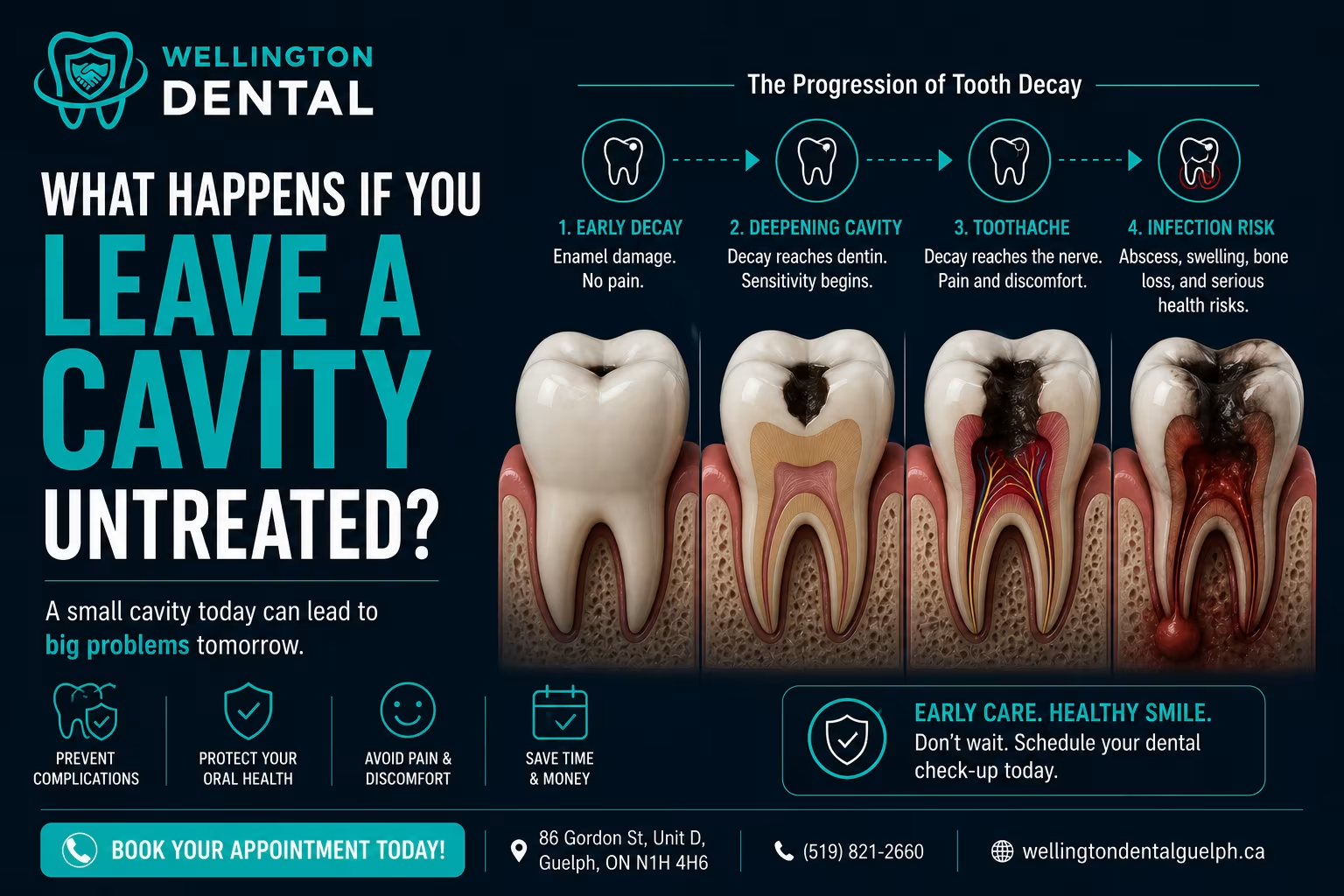
Phase 1: The Invisible Attack (Enamel Erosion)
The earliest stage of a cavity is often invisible to the naked eye. It starts when the bacteria in your mouth feast on sugars and produce acid. This acid leaches minerals from your tooth enamel, creating "white spots" on the surface.
At this stage, the decay hasn't actually created a hole yet—it has just weakened the armor. If you catch the problem here, you might not even need a filling. A professional Dental Fluoride Treatment in Guelph can actually help remineralize the enamel and "reverse" the early damage. This is why regular check-ups with a Family Dentist Guelph are so critical; we can see the battle beginning before the "enemy" breaks through the gate.
Phase 2: Crossing the Threshold (Dentin Decay)
If the early erosion isn't addressed, the acid eventually breaks through the enamel and reaches the next layer: the dentin. Dentin is much softer than enamel and contains tiny tubes that lead directly to the nerve of the tooth.
Once a Dental Cavity hits the dentin, the speed of decay accelerates. This is usually when you start to feel the first "zings" of sensitivity when drinking a cold glass of water or eating something sweet. If a Cavity Is Left at this stage, the hole will continue to widen and deepen. A simple resin filling (a standard Cavity Treatment) is the typical solution here, restoring the tooth's structure and stopping the bacteria in its tracks.
Phase 3: The Danger Zone (Pulp Involvement)
The center of your tooth is a soft chamber called the pulp, which houses the blood vessels and nerves. This is the tooth's "life center." When decay reaches this depth, the situation changes from a "cavity" to an "infection."
At this point, the pain is no longer a fleeting sensitivity; it is a persistent, throbbing ache that can keep you up at night. The bacteria are now actively attacking the living tissue inside your tooth. To save the tooth from here, a Guelph Family Dentistry specialist will likely need to perform a root canal to remove the infected pulp and seal the tooth.
Phase 4: The Abscess and Beyond
If you continue to ignore the pain—or if the nerve eventually "dies" and the pain temporarily disappears—you have reached the most dangerous stage. The infection doesn't stop at the tooth; it travels down the root and into the jawbone, creating a pocket of pus known as an abscess.
An abscess can cause:
-
Severe facial swelling.
-
A bitter taste in the mouth.
-
Fever and swollen lymph nodes.
-
Bone loss around the root.
In extreme cases, the infection can enter the bloodstream (sepsis) or travel to the sinuses or brain. At this stage, the tooth may be beyond saving and require extraction by a Family Dentist in Guelph.
Why Do We Wait? (The Psychology of Procrastination)
Most people don't leave a cavity untreated because they want to lose a tooth. Usually, it's a combination of:
-
Lack of Pain: We are wired to think "no pain = no problem." In dentistry, by the time it hurts, the problem is already advanced.
-
Dental Anxiety: The fear of the chair is real. However, modern Dental Cavity Treatment is virtually painless thanks to advanced numbing agents and gentle techniques.
-
Cost Concerns: A small filling is significantly less expensive than a root canal, crown, or dental implant. Treating a cavity early is always the most budget-friendly move.
Frequently Asked Questions
1. How long can a cavity go untreated before it becomes an emergency?
There is no "safe" timeline because decay progresses at different rates based on your diet, oral hygiene, and the thickness of your enamel. For some, a Dental Cavity can take a year to move through the enamel; for others, it can reach the nerve in just a few months. The best rule is to treat it the moment it is diagnosed.
2. Can I stop a cavity from getting worse by brushing more?
Once a physical hole (cavity) has formed in the dentin, brushing and flossing cannot stop it. While good hygiene can slow the bacteria down slightly, the decay is "tucked away" inside a hole where your toothbrush bristles cannot reach. You need professional Cavity Treatment to remove the decay and seal the tooth.
3. Does a cavity always hurt?
No. In fact, most cavities don't hurt at all in their early stages. Enamel does not have nerves, so you won't feel a thing while the bacteria are eating through the outer layer. This is why regular X-rays at your Dental Clinic Guelph are so important—they see what you cannot feel.
4. What are the signs that my cavity has turned into an infection?
If you notice a constant throbbing pain, a "pimple" on your gums (an abscess), foul-smelling breath, or extreme sensitivity to heat that lingers for more than a few seconds, the decay has likely reached the pulp or the root. You should contact a Family Dentist in Guelph immediately.
5. Can a cavity "heal" itself?
Only in the very first stage (demineralization). If you have a "pre-cavity" or a white spot, a Dental Fluoride Treatment in Guelph and improved hygiene can help the enamel repair itself. However, once the enamel is actually broken and a hole is present, the tooth cannot regenerate that lost tissue.
Conclusion: Don't Let a Small Spot Become a Big Problem
Your teeth are the only part of your body that cannot repair themselves once a structural "wound" has occurred. A Dental Cavity is a race against time. By choosing to address a small cavity today, you are avoiding the pain, higher costs, and health risks of a major infection tomorrow.
If it has been a while since your last check-up, or if you suspect you have a Cavity Is Left lingering in your mouth, reach out to a trusted Best Dentist Guelph. Taking an hour out of your day for a simple filling is a small price to pay for a lifetime of healthy smiles.