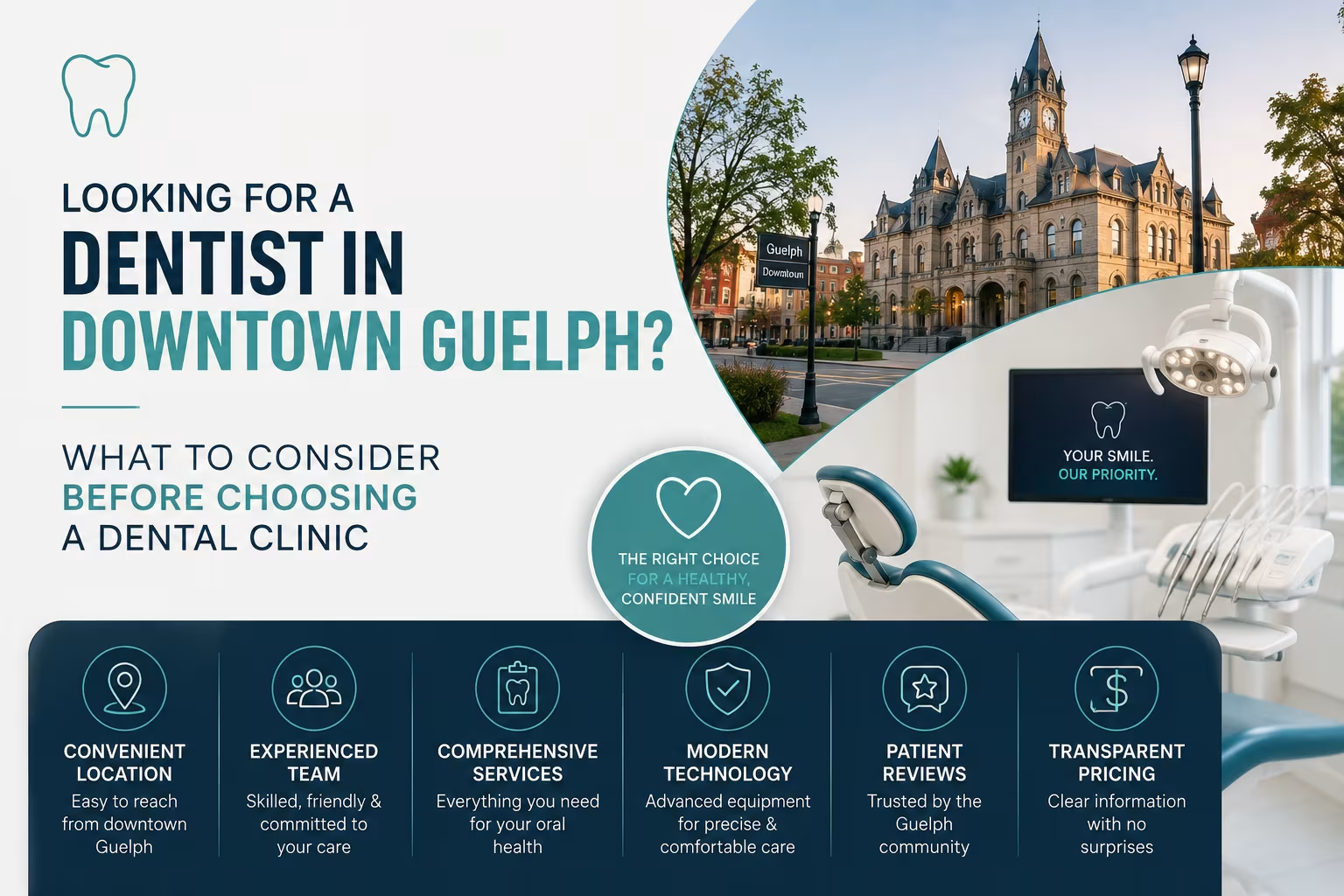
Choosing a dentist is an important decision for you and your family.
You are not simply looking for somewhere to have your teeth cleaned. Ideally, you want a dental clinic that can support your oral health over time, help when unexpected problems occur, explain treatment options clearly, and provide access to the services you may need at different stages of life.
If you are searching for a dentist in Downtown Guelph, you may find many options.
So how do you decide which dental clinic is right for you?
Location matters, but it should not be the only consideration. Services, appointment availability, emergency care, communication, preventive treatment, payment options, and your comfort with the dental team can all influence your experience.
This guide explains some of the most important things to consider when choosing a dentist in Guelph.
1. Start With Location and Convenience
Dental care works best when appointments are practical enough to fit into your life.
A conveniently located dental clinic can make it easier to attend:
- Routine dental examinations
- Dental cleanings
- Follow-up appointments
- Restorative treatments
- Children's dental visits
- Emergency appointments
- Multi-visit treatment plans
For patients living, studying, or working near central Guelph, choosing a Downtown Guelph dental clinic may reduce the time and inconvenience involved in attending appointments.
Wellington Dental Clinic is located at:
Wellington Dental Clinic
86 Gordon St Unit-D
Guelph, ON N1H 4H6
Canada
Its Gordon Street location provides a central option for patients looking for dental care in and around Downtown Guelph.
When comparing dental offices, consider more than the distance from your home.
Ask yourself:
- Is the clinic convenient from home or work?
- Are the operating hours suitable?
- Can family members use the same clinic?
- Is emergency care available?
- Will it be practical to return for follow-up treatment?
Convenience can make maintaining regular dental care considerably easier over the long term.
2. Look at the Range of Dental Services Available
Not every dental clinic provides the same range of treatments.
Your dental needs can also change throughout your life.
At one point, you may only require routine examinations and cleanings. Later, you might need a filling, crown, root canal, tooth extraction, cosmetic treatment, or emergency dental care.
Choosing a clinic that provides a broad range of services can help create continuity in your dental care.
Services to consider may include:
Preventive Dentistry
Preventive dental care focuses on maintaining oral health and identifying problems early.
Services may include:
- Dental examinations
- Professional dental cleanings
- Dental X-rays when indicated
- Fluoride treatment
- Oral hygiene guidance
- Gum health assessment
- Preventive care for children and adults
Routine preventive care can help dentists identify tooth decay, gum problems, damaged restorations, and other concerns before they become more complicated.
Restorative Dentistry
Restorative dentistry focuses on repairing teeth affected by decay, damage, wear, or tooth loss.
Depending on the clinic, services may include:
- Dental fillings
- Dental crowns
- Dental bridges
- Root canal treatment
- Dentures
- Dental implants
- Tooth restoration
Having restorative services available within the same practice may make treatment planning more convenient.
Cosmetic Dentistry
Some patients are interested in improving the appearance of their smile.
Cosmetic dental services can include:
- Teeth whitening
- Dental bonding
- Veneers
- Cosmetic restorations
- Smile enhancement procedures
Cosmetic treatment should still begin with an assessment of your oral health.
Healthy teeth and gums provide the foundation for long-term aesthetic dental treatment.
Oral Surgery
Depending on your needs, you may require procedures such as:
- Tooth extraction
- Wisdom tooth removal
- Surgical dental treatment
If a dental clinic provides oral surgery services, ask which procedures can be completed at the clinic and when referral to another dental professional may be recommended.
Emergency Dentistry
Dental emergencies are difficult to predict.
A severe toothache can begin overnight. A filling can break while eating. A tooth can become damaged during sports or an accident.
Choosing a clinic that provides emergency dental assessment can be particularly useful when an unexpected problem occurs.
3. Check Whether Emergency Dental Care Is Available
Emergency care should be an important consideration when selecting a dental clinic.
Common reasons patients may need urgent dental attention include:
- Severe toothache
- Broken tooth
- Cracked tooth
- Knocked-out permanent tooth
- Dental abscess
- Facial or gum swelling
- Lost filling
- Lost crown
- Dental trauma
- Severe wisdom tooth pain
- Significant dental bleeding
If you develop one of these problems, having an established relationship with a dental clinic can make it easier to know who to contact.
When researching dentists in Guelph, ask:
Does the clinic provide emergency dental appointments?
Also ask what you should do if an emergency occurs outside normal appointment times.
Some dental problems require prompt attention, while serious symptoms such as difficulty breathing or swallowing, severe facial or neck swelling, uncontrolled bleeding, or significant facial trauma may require immediate hospital emergency care.
4. Consider the Clinic's Opening Hours
Traditional Monday-to-Friday dental hours do not work for everyone.
Patients may have:
- Full-time jobs
- School
- University schedules
- Childcare responsibilities
- Shift work
- Long commutes
- Other medical appointments
If scheduling is important to you, look at a clinic's current operating hours before becoming a patient.
Availability during evenings or weekends can make dental care easier for busy families and working professionals.
It can also be helpful when an unexpected dental problem develops close to the weekend.
When comparing clinics, consider:
- Weekday availability
- Evening appointments
- Saturday appointments
- Sunday availability
- Emergency scheduling
- Same-day appointment availability
Always confirm current clinic hours directly when booking because schedules can change.
5. Consider Whether the Clinic Can Care for Your Family
Finding separate dentists for different members of the household can make dental care more complicated.
A family dental clinic may provide care for patients at different stages of life.
Depending on the practice, this may include:
- Children's dental care
- Teen dental care
- Adult dentistry
- Preventive treatment
- Restorative dentistry
- Dental care for older adults
Having one dental home for several members of your family can make appointments, records, treatment planning, and ongoing preventive care more convenient.
When choosing a family dentist in Guelph, ask whether the clinic is accepting new patients and which age groups it routinely treats.
6. Look for a Strong Focus on Preventive Dentistry
Good dentistry should not only respond when something hurts.
Preventive dentistry aims to identify potential problems before they become dental emergencies.
Regular dental examinations can help identify issues such as:
- Tooth decay
- Gum inflammation
- Gum disease
- Cracked teeth
- Worn restorations
- Dental infections
- Bite problems
- Changes in oral tissues
Professional dental cleaning also helps remove plaque and hardened deposits that cannot always be effectively removed through brushing and flossing alone.
Your dentist can recommend an appropriate examination and cleaning schedule based on your individual oral health.
A clinic that prioritizes prevention can help patients take a more proactive approach to maintaining their teeth and gums.
7. Pay Attention to How Treatment Is Explained
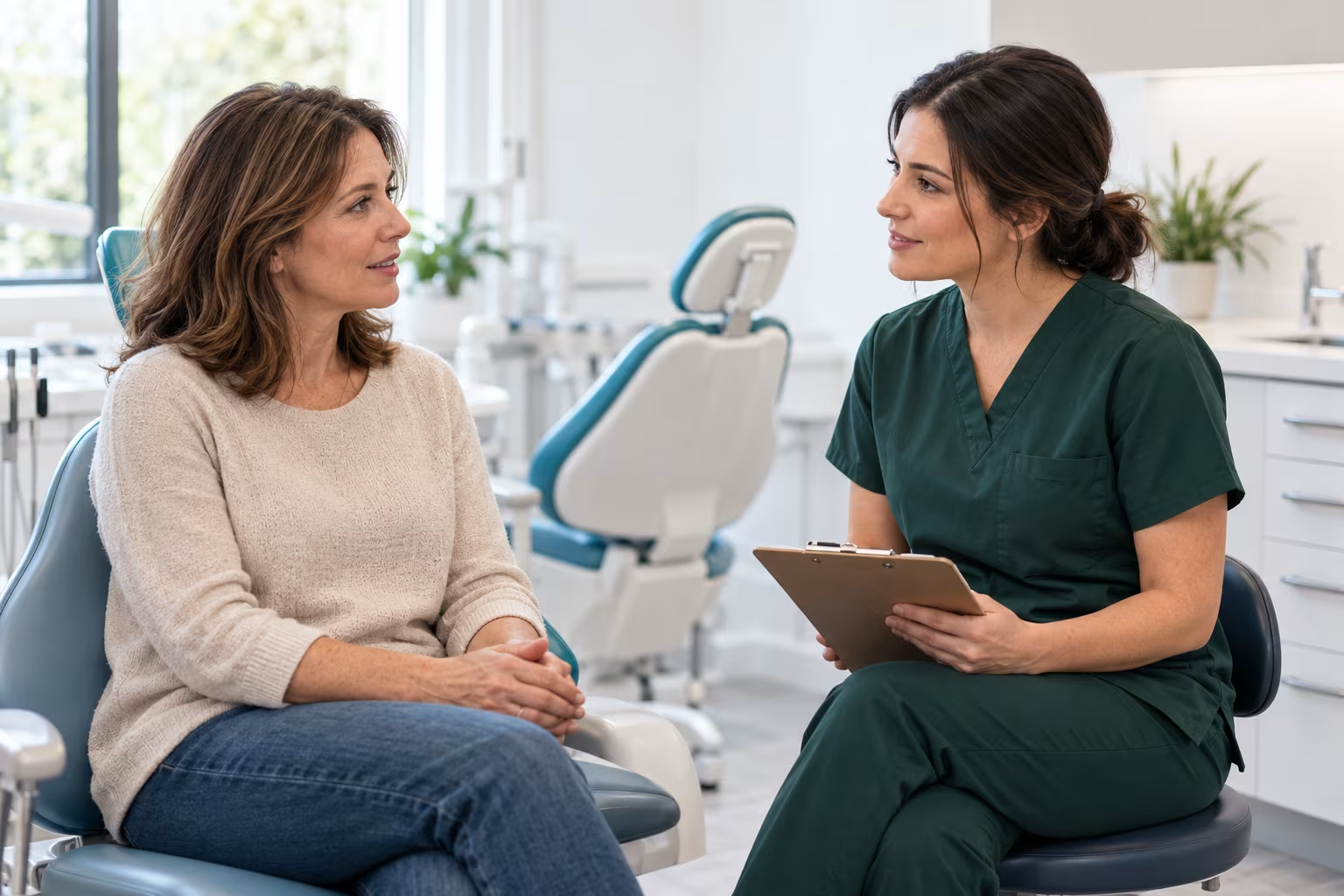
Communication is one of the most important parts of dental care.
Before agreeing to treatment, you should understand:
- What the dentist found
- Why treatment is being recommended
- What the treatment involves
- Reasonable alternatives when available
- Potential risks and benefits
- What may happen if treatment is delayed
- Expected costs
- Whether additional appointments may be needed
You should also feel comfortable asking questions.
Dental terminology can be unfamiliar to patients. A good dental team should be able to explain findings and treatment options in understandable language.
The goal should be informed decision-making rather than simply being told what procedure to book.
8. Ask About Dental Technology
Dental technology continues to evolve.
Depending on the clinic, technology may be used for diagnosis, treatment planning, patient education, restorations, or monitoring changes in oral health.
Examples may include:
- Digital dental X-rays
- Intraoral imaging
- Digital treatment planning
- Modern restorative techniques
- Dental imaging systems
Technology alone does not determine the quality of dental care.
The dentist's clinical judgment, training, communication, and appropriate use of technology remain essential.
However, modern diagnostic tools can help dentists evaluate dental conditions and explain findings to patients.
9. Consider Your Comfort if You Have Dental Anxiety
Dental anxiety is common.
Some people feel slightly nervous before an appointment. Others may avoid dental treatment for years because of fear or previous negative experiences.
If you experience dental anxiety, consider how the clinic approaches nervous patients.
Helpful factors may include:
- Clear explanations
- A calm environment
- The ability to ask questions
- Discussing treatment before beginning
- Appropriate pain-control options
- Sedation options when clinically suitable
If you are particularly anxious about dental treatment, mention this when booking your appointment.
This allows the dental team to better understand your concerns before treatment begins.
10. Ask Whether Sedation Dentistry Is Available
For some patients, sedation may help make certain dental procedures more manageable.
Sedation dentistry may be considered for people who experience:
- Significant dental anxiety
- Fear of dental treatment
- Difficulty tolerating longer procedures
- A strong gag reflex
- Other circumstances where sedation may be clinically appropriate
Sedation is not necessary or suitable for every patient.
Your dentist needs to review your medical history, medications, treatment requirements, and other relevant factors before determining whether a sedation option is appropriate.
If anxiety has prevented you from seeing a dentist, asking about available options can be an important first step.
11. Understand Dental Fees Before Starting Treatment
Cost is an important consideration for many patients.
Before significant dental treatment begins, ask for an explanation of the expected fees.
Questions you may want to ask include:
- What will this treatment cost?
- Is an estimate available?
- Will my insurance cover this procedure?
- Does the clinic offer direct billing?
- Is there an amount I need to pay myself?
- Are there alternative treatment options?
- Will treatment require multiple appointments?
Dental insurance plans vary considerably.
Having dental insurance also does not necessarily mean every procedure is fully covered.
Understanding your financial responsibility before treatment can help prevent unexpected expenses.
12. Ask About Direct Insurance Billing
Some dental clinics can submit eligible insurance claims directly to the patient's insurance provider.
This is commonly referred to as direct billing.
Direct billing can simplify the administrative side of dental treatment, but patients remain responsible for understanding their individual insurance coverage.
Insurance plans can have:
- Annual maximums
- Deductibles
- Co-payments
- Frequency limitations
- Waiting periods
- Excluded procedures
- Different reimbursement percentages
Your dental clinic may be able to help you understand an estimate, but the final responsibility for understanding your insurance policy remains with you and your insurance provider.
13. Check Whether the Clinic Accepts CDCP Patients
The Canadian Dental Care Plan (CDCP) has become an important consideration for eligible Guelph residents looking for dental care.
The federal program helps eligible Canadians who do not have access to private dental insurance reduce the cost of certain oral health services.
If you have CDCP coverage, ask the clinic:
- Are you currently accepting CDCP patients?
- Can you verify my active coverage?
- Will you submit eligible claims directly?
- Will I have a co-payment?
- Could I have additional out-of-pocket costs?
- Does my treatment require preauthorization?
CDCP coverage does not necessarily mean every dental procedure is completely free.
Coverage depends on CDCP rules, eligible services, your applicable co-payment level, CDCP-established fees, and the treatment provided.
Confirm your coverage before treatment whenever possible.
14. Consider Whether New Patients Are Welcome
If you recently moved to Guelph, have changed dentists, are attending university, or simply have not visited a dentist for several years, you may be looking for a dental clinic accepting new patients.
When calling a dental office, ask:
“Are you currently accepting new patients?”
If the answer is yes, also ask what is involved in the first appointment.
A new-patient visit may include:
- Review of your dental history
- Review of your medical history
- Discussion of current concerns
- Dental examination
- Dental X-rays when appropriate
- Gum health assessment
- Discussion of recommended treatment
- Preventive care planning
If you have previous dental records or recent X-rays, ask whether they should be transferred to your new clinic.
15. Don't Avoid the Dentist Because It Has Been Years
Many patients feel embarrassed when they have not visited a dentist for a long time.
You may be worried about:
- Cavities
- Broken teeth
- Gum disease
- Missing teeth
- Bad breath
- The appearance of your smile
- The potential cost of treatment
- Being judged
Avoiding an appointment generally does not make dental problems easier to manage.
If it has been several years since your last dental visit, the first goal is simply to understand your current oral health.
Your dentist can identify which issues require attention and discuss treatment priorities with you.
You do not need to solve every dental problem before making the appointment.
The appointment is where that process begins.
16. Read Patient Reviews, But Use Them Wisely
Online reviews can provide useful insight into a dental practice.
Patients often comment on:
- Communication
- Appointment scheduling
- Staff interactions
- Clinic environment
- Wait times
- Their overall experience
However, reviews should be considered alongside other factors.
Every patient's dental condition, treatment, expectations, and experience are different.
Rather than focusing only on a clinic's overall rating, look for recurring themes across multiple reviews and consider whether those factors matter to you.
17. Look for Continuity of Care
Dentistry is often easier when your dental team understands your history.
Over time, dental records can help track:
- Existing restorations
- Previous dental treatment
- Gum health
- Tooth wear
- Changes visible on X-rays
- Recurring problems
- Your treatment preferences
Establishing a regular dental home can provide continuity rather than seeking a different clinic each time a problem develops.
This can be particularly helpful for families and patients with ongoing restorative or periodontal needs.
18. Know What to Expect at Your First Dental Appointment
Your first visit gives both you and your dentist an opportunity to understand your oral health needs.
The appointment may begin with a discussion about:
- Your medical history
- Current medications
- Previous dental treatment
- Dental concerns
- Tooth sensitivity
- Pain
- Dental anxiety
- Cosmetic concerns
A clinical examination can then assess your teeth, gums, bite, existing restorations, and surrounding oral tissues.
Dental X-rays may be recommended when clinically appropriate.
After the assessment, your dentist can discuss findings and recommend next steps.
Depending on your oral health, these may range from routine preventive care to treatment for cavities, gum problems, damaged teeth, or other conditions.
19. What Questions Should You Ask a New Dentist?
Before choosing a dental clinic, asking a few practical questions can make the decision easier.
Consider asking:
- Are you accepting new patients?
- Do you provide family dentistry?
- Do you offer emergency appointments?
- Are weekend or evening appointments available?
- What services are provided at the clinic?
- Do you offer sedation options?
- Do you provide direct insurance billing?
- Do you accept eligible CDCP patients?
- What should I expect at my first appointment?
- What should I bring with me?
- How are treatment costs explained?
The answers can help you determine whether the clinic fits your needs.
20. When Should You Book a Dental Appointment?
You do not need to wait until something hurts before seeing a dentist.
Consider scheduling an appointment if:
- You are due for a dental examination
- You need a professional dental cleaning
- Your gums bleed regularly
- A tooth has become sensitive
- You have persistent bad breath
- A filling or crown feels damaged
- You have chipped or cracked a tooth
- You are experiencing tooth pain
- You have swelling around a tooth or gum
- You are considering cosmetic dental treatment
- You have not visited a dentist for several years
Some dental conditions can develop with few obvious symptoms.
Regular assessment can help identify problems earlier.
What If You Need an Emergency Dentist in Downtown Guelph?
If you suddenly develop severe dental pain or experience a dental injury, contact a dental professional promptly.
Examples of problems that may require urgent assessment include:
- Severe or persistent toothache
- Significant dental swelling
- A knocked-out permanent tooth
- A badly broken tooth
- Suspected dental infection
- Significant bleeding
- Dental trauma
For a knocked-out permanent tooth, time can be particularly important.
If serious swelling affects your ability to breathe or swallow, or you experience uncontrolled bleeding or severe facial trauma, seek emergency medical attention.
Choosing a Dentist Near Gordon Street in Guelph
For patients who live, work, study, or regularly travel through central Guelph, Gordon Street can be a convenient location for dental care.
Wellington Dental Clinic is located at:
86 Gordon St Unit-D, Guelph, ON N1H 4H6, Canada
Our Downtown Guelph location provides access to a broad range of dental services for patients with different oral health needs.
Services available through the clinic include preventive, general, restorative, cosmetic, emergency, and surgical dental care based on individual patient requirements.
If you are looking for a new dentist, you can contact the clinic to discuss appointment availability and the dental services you need.
Frequently Asked Questions About Choosing a Dentist in Guelph
How do I choose a good dentist in Guelph?
Consider location, services, appointment availability, emergency care, communication, preventive dentistry, treatment options, insurance billing, CDCP participation, and whether you feel comfortable with the dental team.
Is Wellington Dental Clinic located in Downtown Guelph?
Wellington Dental Clinic is located at 86 Gordon St Unit-D, Guelph, ON N1H 4H6, providing a central location for patients seeking dental care in Guelph.
How often should I visit a dentist?
There is no single schedule that is appropriate for every patient. Your dentist can recommend an examination and preventive-care schedule based on your oral health, risk factors, treatment history, and individual needs.
Should I choose a dentist close to home?
Convenience is useful because it can make routine and follow-up appointments easier to attend. However, location should be considered alongside quality of care, available services, hours, communication, and your individual dental needs.
Can one dental clinic treat my whole family?
Many family dental clinics provide care for children, adults, and older patients. Confirm which age groups and services the clinic currently provides before booking.
What should I look for in an emergency dentist?
Consider how the clinic handles urgent appointments, which emergency services it provides, its opening hours, and what patients should do outside regular clinic hours.
What if I am afraid of going to the dentist?
Tell the dental clinic about your anxiety when booking. Clear communication, appropriate pain management, gradual treatment planning, and sedation options when clinically appropriate may help some patients manage dental anxiety.
Does Wellington Dental Clinic accept new patients?
Patients looking for a new dentist in Guelph can contact Wellington Dental Clinic directly to confirm current new-patient availability and arrange an appropriate appointment.
Can I use the Canadian Dental Care Plan at a dentist in Guelph?
Eligible Guelph residents can use CDCP coverage with participating oral health providers. Contact the dental clinic before treatment to confirm current CDCP participation, your active coverage, potential co-payments, and whether preauthorization is required.
What should I bring to my first dental appointment?
You may need identification, insurance or CDCP information, a list of medications, relevant medical information, and previous dental records or X-rays when available.
Should I see a dentist even if my teeth don't hurt?
Yes. Dental problems such as early tooth decay and gum disease may not always cause noticeable pain. Preventive dental examinations can help identify concerns before symptoms become more significant.
Looking for a Dentist in Downtown Guelph?
Choosing a dental clinic is about finding a place where you can receive appropriate care not just today, but over the years ahead.
Consider the factors that matter most to you:
Convenient location.
Appointment availability.
Preventive care.
Emergency dentistry.
Family dental services.
Restorative and cosmetic treatment options.
Clear communication.
Insurance and CDCP support.
Comfort and continuity of care.
If you are looking for a dentist in Downtown Guelph, contact Wellington Dental Clinic to discuss your dental needs and current appointment availability.
Wellington Dental Clinic
86 Gordon St Unit-D
Guelph, ON N1H 4H6
Canada
Whether you are due for a routine dental examination, have a specific concern, need emergency dental care, or are simply looking for a new dental home in Guelph, getting started begins with an assessment of your individual oral health.
This article is intended for general educational purposes and is not a substitute for diagnosis, treatment, or personalized advice from a qualified dental professional. Dental services, clinic hours, appointment availability, insurance participation, and CDCP policies may change. Confirm current information directly with the clinic before booking.