
When a tooth is severely damaged by decay or a sudden fracture, a Dental Crown
is often the gold standard for saving it. Think of a crown as a custom-fitted "helmet" that reinforces the remaining structure, preventing further cracks and restoring your ability to chew and smile with confidence.
However, a crown isn't magic. It requires a physical foundation to hold onto. One of the most common questions patients ask at a Dental Office Guelph is: how much tooth is needed for a crown?
If you’ve been told you have a "broken tooth" or a "deep cavity," understanding the mechanics of how a crown stays in place can help you make an informed decision about your oral health.
The Foundation: Why Tooth Structure Matters
To understand why the amount of remaining tooth is so critical, imagine trying to build a house on a crumbling foundation or a very narrow pillar. No matter how beautiful the house is, it won't stand the test of time if the base isn't secure.
A crown works by "grabbing" onto the natural tooth structure that sits above the gum line. If there isn't enough surface area for the dental cement to bond with, the crown will frequently pop off, or worse, the underlying tooth will snap under the pressure of your bite.
In the world of restorative dentistry, we look for a specific "magic number" to ensure long-term success.
The 2mm Rule: The Ferrule Effect
In clinical terms, the most important factor in determining how much tooth is needed for a crown is called the Ferrule Effect.
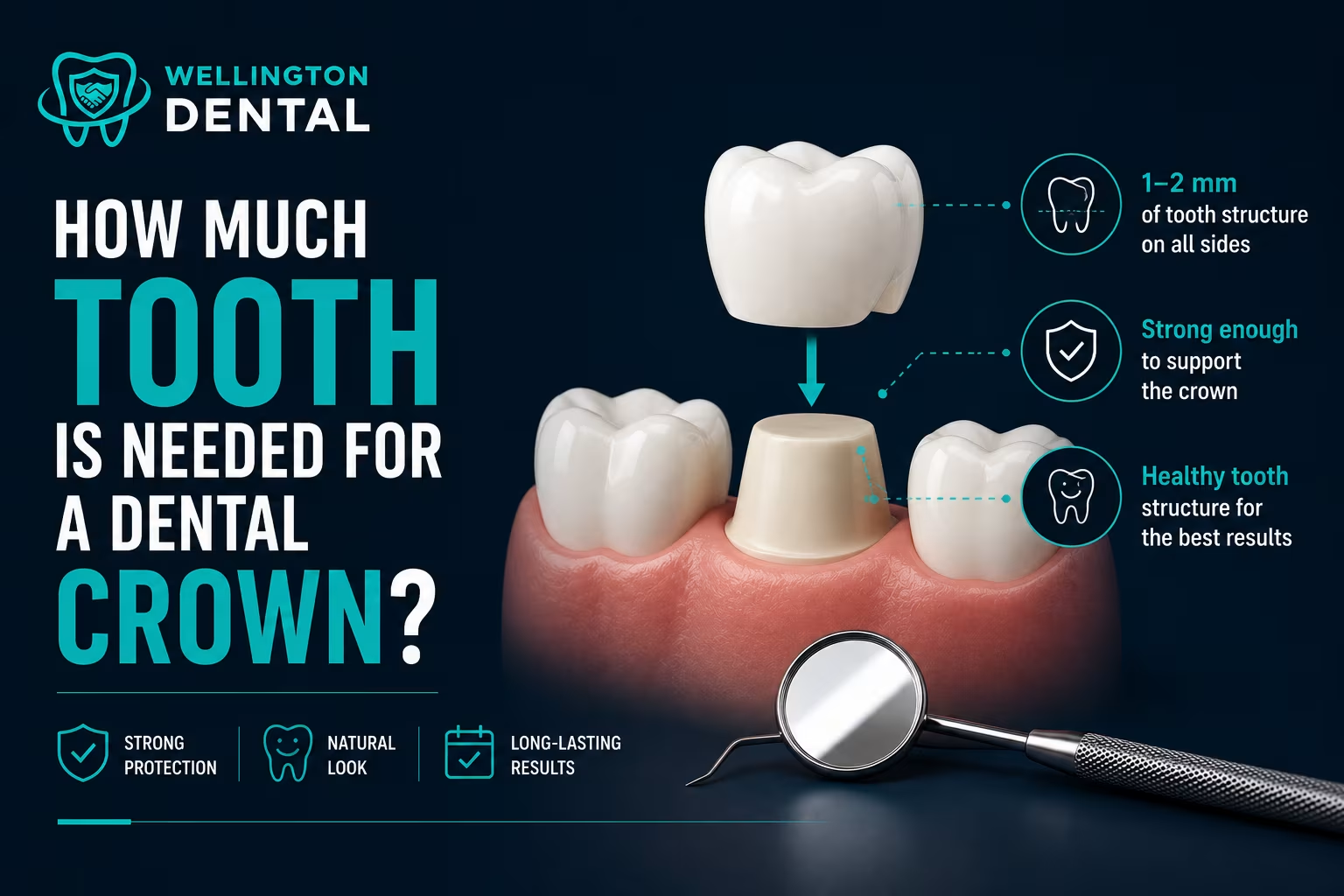
A "ferrule" is a structural band that encircles the tooth, much like the metal band that holds the eraser onto a pencil. For a crown to be successful, a dentist generally needs at least 2 millimeters of sound, healthy tooth structure extending above the gum line, all the way around the circumference of the tooth.
Why 2mm? This height provides enough "grip" for the Dental Crowns in Guelph to resist the lateral, or side-to-side, forces that occur when you grind or chew food. Without this 2mm band of natural tooth, the crown relies entirely on the internal post or cement, which significantly increases the risk of the tooth fracturing at the root.
What If There Isn’t Enough Tooth Left?
If you have a tooth that is broken down to the gum line, don't lose hope just yet. Modern Dentistry in Guelph offers several techniques to "rebuild" a foundation where one has been lost.
1. Core Buildup
This is the most common solution. If a large portion of the tooth is missing due to a cavity, but the roots are healthy, the Best Dentist Guelph will use a specialized, high-strength filling material, such as composite resin, to "build up" the center of the tooth. This creates a sturdy "stump" that the crown can then be bonded to.
2. Post and Core
In cases where a tooth has had a root canal, the internal structure is often hollow. To provide stability, a small post, made of metal or carbon fiber, is placed into the root canal space. The core buildup is then built around this post.
This anchor system allows dental crowns to stay secure even when very little of the original crown remains.
3. Crown Lengthening
Sometimes, the 2mm of tooth we need is actually there, but it’s hidden beneath the gum line. In a procedure called crown lengthening, a dentist or periodontist gently reshapes the gum tissue and a tiny bit of the surrounding bone to expose more of the natural tooth.
This "unlocks" enough surface area to safely place a crown.
When a Tooth Can’t Be Saved
While we always strive to save the natural tooth, there is a "tipping point" where a crown is no longer a viable option. If the decay has traveled deep into the root, or if the fracture extends vertically down the root under the bone, the tooth's structural integrity is compromised beyond repair.
In these instances, trying to force a crown onto a failing foundation is a disservice to the patient. It often leads to repeated failures and unnecessary pain. A Family Dentist Guelph will be honest with you if an extraction and a dental implant are the more predictable, long-term solutions for your smile.
The Role of Material and Precision
The type of crown you choose also plays a role in how much tooth must be removed during preparation.
-
Zirconia and Metal Crowns: These materials are incredibly strong even when they are thin, meaning the dentist can often be more conservative and leave more of your natural tooth intact.
-
All-Porcelain Crowns: These require slightly thicker walls for strength, which may require a bit more of the natural tooth to be "shaved down" to make room for the ceramic.
Choosing a skilled provider at a Dental Office Guelph ensures that the "prep" is done with microscopic precision, preserving every possible millimeter of your natural enamel.
Frequently Asked Questions
1. Can you put a crown on a tooth that is broken to the gum line?
It is difficult, but often possible through "crown lengthening" or "post and core" procedures. However, if the fracture goes below the bone level, the tooth usually cannot be saved with a crown and may need to be replaced with an implant.
2. How much of my natural tooth is shaved down for a crown?
Usually, about 1mm to 2mm of enamel is removed from the top and sides of the tooth. This creates space so that the Dental Crown can sit flush with your other teeth and doesn't feel "bulky" in your mouth.
3. Is it painful to get a tooth prepared for a crown?
Not at all. The area is completely numbed with local anesthesia. You might feel some pressure as the dentist shapes the tooth, but you should not feel any sharp pain. After the appointment, the tooth may be slightly sensitive for a day or two, but this is easily managed with over-the-counter relievers.
4. How long does a crown last if the foundation is weak?
If the "ferrule effect" is missing, meaning there is less than 2mm of natural tooth, a crown might only last a few years before the cement fails or the tooth breaks. When the foundation is strong, a dental crown can easily last 15 years or more.
5. Why did my crown fall off with the "stump" still inside it?
This usually happens when the natural tooth underneath has fractured or decayed further. If the "bond" between the crown and the tooth was stronger than the tooth itself, the tooth can snap off at the gum line. This is why ensuring we have enough healthy structure before placing the crown is so vital.
6. Does insurance cover the "core buildup" needed for a crown?
Most insurance plans do cover a portion of a core buildup, as they recognize it is a necessary step to ensure the Dental Crown succeeds. Our team at the Family Dentist Guelph can help you navigate your specific coverage.
Conclusion
Determining how much tooth is needed for a crown is a blend of biology and engineering. By respecting the "2mm rule" and using modern rebuilding techniques, we can save teeth that might have been lost just a decade ago.
If you’re worried about a damaged tooth, don't wait for it to break further. Early intervention is the key to preserving as much of your natural smile as possible. Visit a Best Dentist Guelph today for a comprehensive evaluation and a customized restoration plan.