
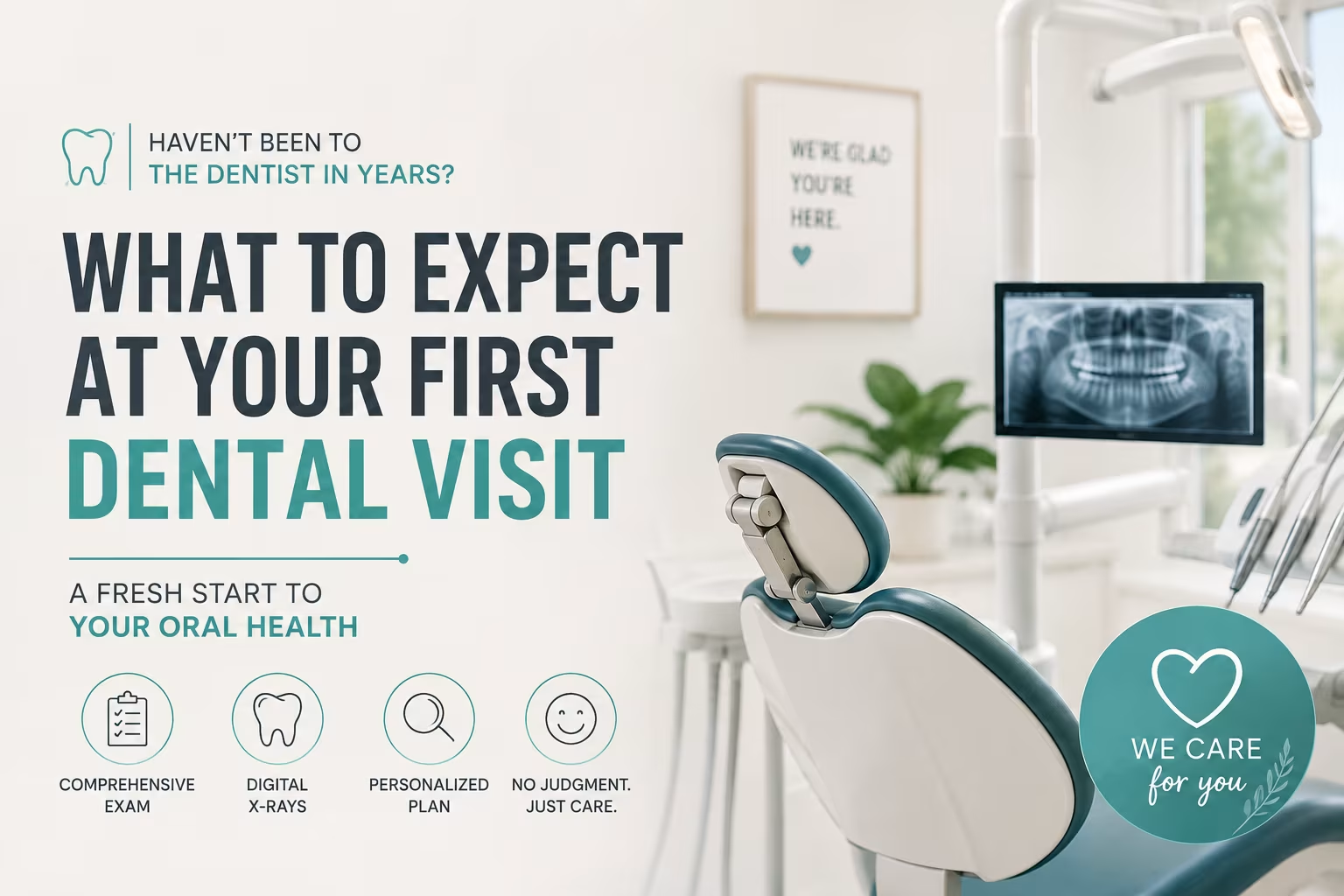
Maybe it has been two years since your last dental appointment.
Maybe five.
Maybe ten or more.
If you haven't been to the dentist in a long time, making that first appointment can feel more difficult than it sounds.
You may be thinking:
“What if my teeth are in really bad condition?”
“Will the dentist judge me?”
“Is the appointment going to hurt?”
“What if I need a lot of dental work?”
“How much is this going to cost?”
These concerns can make people continue postponing dental care even when they know they should make an appointment.
If you haven't visited a dentist for several years, the goal of your first appointment is not to criticize the past.
The goal is to understand your current oral health, identify problems that may need attention, and develop an appropriate plan for moving forward.
If you are looking for a new dentist in Guelph after a long break from dental care, here's what you can generally expect.
Is It Bad That I Haven't Been to the Dentist in Years?
Going several years without professional dental care can increase the possibility that an oral health problem has developed without being detected.
However, avoiding the dentist because you are worried about what might be found only extends the period without assessment.
Dental problems can vary considerably.
Some patients return after several years and need relatively straightforward preventive or restorative treatment.
Others may have conditions that require more extensive care.
The only reliable way to know is to have your oral health evaluated.
Your first appointment is the starting point.
Will the Dentist Judge Me?
Fear of being judged is one reason some people delay dental appointments.
You may feel embarrassed about:
- Tooth decay
- Broken teeth
- Missing teeth
- Stained teeth
- Gum problems
- Bad breath
- Not brushing or flossing consistently
- Previous dental problems
- How long it has been since your last appointment
These concerns are understandable, but they should not prevent you from seeking care.
Dental professionals regularly see patients with many different levels of oral health and dental history.
The useful question is not:
“Why didn't I come sooner?”
It is:
“What can I do now?”
A productive dental appointment should focus on assessing your condition, discussing appropriate treatment, and helping you make informed decisions about your oral health.
What Happens at Your First Dental Appointment?
The exact appointment varies depending on your symptoms, dental history, age, medical history, and the clinic's assessment process.
A comprehensive new-patient visit may include several steps.
1. Reviewing Your Medical History
Oral health and general health are connected in several important ways.
Before treatment, the dental team may ask about:
- Medical conditions
- Previous surgeries
- Allergies
- Current medications
- Previous reactions to medications
- Pregnancy when relevant
- Relevant hospitalizations
- Other health information that may affect dental treatment
Provide accurate information even if something does not seem directly related to your teeth.
Some health conditions and medications can influence treatment planning, bleeding, healing, saliva production, sedation, or other aspects of dental care.
2. Discussing Your Dental History
Your dentist may ask about your previous dental experiences.
This can include:
- When you last visited a dentist
- Previous fillings
- Crowns
- Root canal treatment
- Tooth extractions
- Wisdom tooth treatment
- Gum treatment
- Orthodontic treatment
- Dental implants
- Dentures
- Previous dental injuries
If you had a difficult dental experience in the past, mention it.
Understanding what made you uncomfortable can help your dental team communicate with you more effectively.
3. Talking About Your Current Concerns
You do not need to know the technical name for your dental problem.
Simply explain what you have noticed.
For example:
- “This tooth hurts when I chew.”
- “My gums bleed when I brush.”
- “One of my fillings feels broken.”
- “My teeth have become sensitive.”
- “I have a wisdom tooth that hurts.”
- “I don't like the appearance of my front teeth.”
- “I haven't had my teeth cleaned in years.”
- “I'm extremely nervous about dental treatment.”
These details help your dentist understand what matters most to you.
4. Dental Examination
Your dentist will examine your mouth to evaluate your current oral health.
Depending on your individual needs, this may involve assessing:
- Teeth
- Existing fillings
- Crowns
- Bridges
- Dental implants
- Gum tissues
- Bite
- Areas of tooth wear
- Cracked or damaged teeth
- Areas of possible decay
- Missing teeth
- Other oral tissues
The purpose is to establish a clearer picture of your current condition.
5. Will I Need Dental X-Rays?
Possibly.
Dental X-rays provide information about areas that cannot always be fully evaluated through visual examination alone.
Depending on your needs, X-rays may help assess:
- Tooth decay
- Tooth roots
- Bone around teeth
- Existing restorations
- Dental infections
- Impacted teeth
- Wisdom teeth
- Other conditions
You do not automatically need every type of dental X-ray.
The dentist determines which images are appropriate based on your history, clinical findings, previous imaging, symptoms, and individual risk factors.
If another dental clinic recently took X-rays, ask whether those records can be transferred.
6. Your Gum Health May Be Checked
If it has been several years since your last dental visit, evaluating your gums can be particularly important.
Gum disease does not always cause significant pain in its earlier stages.
Possible warning signs include:
- Bleeding gums
- Red or swollen gums
- Persistent bad breath
- Gum recession
- Tooth sensitivity
- Loose teeth
- Changes around the gums
Your dental team may evaluate gum health and the supporting structures around your teeth.
The findings can help determine what type of professional cleaning or periodontal care may be appropriate.
7. Will My Teeth Be Cleaned at the First Appointment?
Maybe, but not always.
Whether a professional cleaning is completed during the same visit depends on factors such as:
- Your oral health
- The condition of your gums
- The amount of buildup present
- The type of cleaning required
- Available appointment time
- Whether another dental concern needs priority
If significant gum disease or heavy buildup is present, your dental team may recommend a different approach than a routine cleaning.
The treatment plan should be based on what your mouth actually needs.
What If I Have a Lot of Plaque or Tartar?
Do not let this stop you from making an appointment.
Professional dental cleaning exists precisely because some deposits cannot be removed effectively with a toothbrush at home.
Plaque that remains on teeth can harden into calculus, often called tartar.
Once hardened, it generally requires professional removal.
If you have substantial buildup, your dental team can assess your gums and recommend an appropriate cleaning plan.
What If My Gums Bleed?
Bleeding gums can occur for several reasons and should not simply be ignored.
Common contributing factors can include plaque accumulation and gum inflammation.
Depending on the situation, bleeding may also be associated with more significant periodontal problems or other factors.
If your gums regularly bleed while brushing or flossing, mention this during your appointment.
Your dentist or dental hygienist can assess your gum health and recommend appropriate care.
What If the Dentist Finds Cavities?
Finding a cavity does not automatically mean you have a major dental problem.
The appropriate treatment depends on factors such as:
- Size of the cavity
- Location
- Depth
- Condition of the remaining tooth
- Whether symptoms are present
- Whether the dental pulp is involved
Smaller areas of decay may be treatable with a dental filling.
More extensive damage may require other restorative treatment.
Your dentist should explain what was found and why a particular treatment is being recommended.
What If I Have Several Dental Problems?
This is one of the biggest concerns for patients returning after a long absence.
You might imagine being told that everything needs treatment immediately.
In reality, treatment can often be organized according to priority.
For example:
Urgent Problems
These may include:
- Severe pain
- Dental infection
- Significant swelling
- Dental trauma
- Certain broken teeth
- Other conditions requiring prompt treatment
Active Dental Disease
This can include cavities, damaged restorations, gum problems, or other conditions that need treatment but may not represent an immediate emergency.
Preventive Needs
These may include professional cleaning, fluoride treatment when appropriate, oral hygiene improvement, or monitoring.
Elective Treatment
Cosmetic procedures and other non-urgent treatment can often be discussed after oral health has been stabilized.
A treatment plan allows care to be organized rather than approaching everything at once.
Do I Have to Complete Every Recommended Treatment Immediately?
Not necessarily.
Some dental problems require prompt attention, while others may be monitored or scheduled according to clinical priority.
Your dentist should explain:
- What was found
- Which problems are most urgent
- Recommended treatment
- Reasonable alternatives when available
- Potential consequences of delaying treatment
- Expected costs
You can then make informed decisions about your care.
However, delaying treatment for active disease can sometimes allow the condition to progress, so it is important to understand the potential risks of waiting.
What If I Can't Afford All My Dental Treatment at Once?
Cost is a genuine concern for many patients.
If several treatments are recommended, ask whether care can be prioritized or staged when clinically appropriate.
A treatment plan may help separate:
- Urgent treatment
- Necessary restorative treatment
- Preventive care
- Longer-term treatment
- Elective treatment
Ask for estimates before proceeding with significant dental work.
If you have private dental insurance or CDCP coverage, the clinic may also be able to help determine which proposed services may be eligible for benefits.
What If I Don't Have Dental Insurance?
Not having private dental insurance should not prevent you from asking a dental clinic about your options.
Before treatment, request information about:
- Examination fees
- X-ray costs when required
- Cleaning fees
- Proposed treatment costs
- Available treatment alternatives
- Payment expectations
If you qualify for the Canadian Dental Care Plan (CDCP), you may have coverage for certain eligible dental services.
Eligibility and the amount covered depend on current federal program rules.
Can I Use the Canadian Dental Care Plan?
The Canadian Dental Care Plan is designed to help eligible Canadian residents who do not have access to private dental insurance reduce the cost of eligible oral health care.
Depending on current CDCP rules and your individual eligibility, eligible services can include certain:
- Dental examinations
- X-rays
- Preventive services
- Fillings
- Root canal treatments
- Periodontal services
- Tooth extractions
- Denture-related services
- Other eligible dental procedures
CDCP coverage does not necessarily mean every service is completely free.
You may have a co-payment or other out-of-pocket amount.
If you have CDCP coverage, mention it when booking your appointment so the dental clinic can review the relevant information.
What If I Have Private Dental Insurance?
Bring your current dental insurance information to your appointment.
Depending on the clinic and insurance provider, eligible claims may be submitted directly.
However, dental insurance plans vary.
Your plan may include:
- Annual maximums
- Deductibles
- Co-payments
- Frequency limitations
- Coverage percentages
- Exclusions
- Waiting periods
Insurance coverage should not be confused with a dental treatment recommendation.
Your dentist recommends care based on clinical findings, while your insurance provider determines what portion of eligible treatment it will reimburse under your plan.
I'm Terrified of Dentists. What Should I Do?
Tell the clinic before your appointment.
You do not need to hide dental anxiety.
It is common for patients to feel nervous because of:
- Previous negative experiences
- Fear of pain
- Needles
- Dental sounds
- Feeling out of control
- Embarrassment about their teeth
- Uncertainty about treatment
- Financial concerns
Knowing that you are anxious allows the dental team to better understand your concerns.
How Can I Make My First Appointment Less Stressful?
A few practical steps may help.
Tell the Clinic You're Nervous
Mention your anxiety while booking rather than waiting until treatment begins.
Ask Questions
Understanding what will happen can reduce uncertainty.
Agree on a Stop Signal
You may be able to establish a simple hand signal to indicate that you need a pause during treatment.
Avoid Hiding Important Information
Tell your dentist about previous difficult experiences, medical conditions, and medications.
Ask About Pain Management
If treatment is required, ask what methods are available to keep you comfortable.
Discuss Sedation When Appropriate
If you have significant dental anxiety, ask whether sedation may be appropriate for your situation.
What Is Sedation Dentistry?
Sedation dentistry involves using appropriate medication to help certain patients feel more relaxed during dental treatment.
It may be considered for patients with:
- Significant dental anxiety
- Fear of treatment
- Difficulty tolerating longer procedures
- Strong gag reflexes
- Other appropriate clinical circumstances
Sedation does not automatically mean that you are unconscious.
Different approaches produce different levels of relaxation.
The appropriate option depends on the procedure, your medical history, medications, anxiety level, and other clinical considerations.
Is Sedation Dentistry Safe?
Sedation must be selected and administered appropriately based on the patient's health and treatment needs.
Before sedation, your dental provider may review:
- Medical history
- Current medications
- Allergies
- Previous sedation experiences
- Relevant health conditions
- Planned dental treatment
Specific preparation and recovery instructions may apply.
Some forms of sedation also require you to arrange transportation and avoid driving afterward.
Your dentist can explain the risks, benefits, and requirements of any sedation option being considered.
What If I Have Bad Teeth?
Patients sometimes describe themselves as having “bad teeth.”
This phrase can refer to many different situations:
- Multiple cavities
- Missing teeth
- Broken teeth
- Gum disease
- Old dental work
- Staining
- Tooth wear
- Dental infections
These conditions require assessment, not embarrassment.
The important questions are:
What is happening now?
Which problems require treatment?
What can be maintained or restored?
How can future problems be reduced?
A comprehensive dental assessment can begin answering those questions.
What If I Have a Broken Tooth I've Ignored for Years?
A broken tooth should be evaluated even if it currently does not hurt.
The absence of pain does not necessarily mean the tooth is healthy.
Depending on the condition, treatment might involve:
- Dental filling
- Bonding
- Crown
- Root canal treatment
- Extraction
- Another restorative approach
The appropriate treatment depends on how much tooth structure remains and whether decay, infection, or other complications are present.
What If I'm Missing Teeth?
Missing teeth can affect patients differently depending on their location, number, bite, oral health, and individual goals.
Potential replacement options can include:
- Dental implants
- Dental bridges
- Partial dentures
- Complete dentures
Not every option is suitable for every patient.
Your dentist can assess your teeth, gums, bone, bite, medical history, and treatment goals before discussing appropriate possibilities.
What If My Teeth Look Yellow or Stained?
Tooth colour naturally varies.
Discolouration can also be influenced by:
- Coffee
- Tea
- Tobacco
- Certain foods
- Aging
- Existing restorations
- Internal tooth changes
- Other factors
If the appearance of your smile concerns you, mention it during your dental consultation.
Cosmetic options should generally be considered after active decay, gum disease, or other oral health problems have been addressed.
Can I Ask About Teeth Whitening at My First Visit?
Yes.
You can discuss cosmetic concerns during your appointment.
However, your dentist may recommend evaluating your teeth and gums before whitening.
For example, untreated cavities, significant sensitivity, gum problems, or existing restorations can affect treatment planning.
A dental assessment can help determine whether whitening is appropriate and what results may reasonably be expected.
How Long Does a New Patient Dental Appointment Take?
Appointment length varies according to:
- Your dental history
- Oral health
- Number of concerns
- Whether X-rays are required
- Whether cleaning is scheduled
- Complexity of the examination
- Other individual factors
When booking, ask the clinic how much time has been scheduled and what the first visit is expected to include.
Should I Brush My Teeth Before My Dental Appointment?
You can brush and clean between your teeth normally before your appointment.
There is no need to aggressively brush or floss because you are worried about what the dental team might think.
Overly aggressive cleaning can irritate your gums.
Your dentist needs to see your oral health as it actually is.
What Should I Bring to My First Dental Appointment?
It may be helpful to bring:
- Government-issued identification
- Dental insurance information
- CDCP information if applicable
- A list of medications
- Relevant medical information
- Previous dental records when available
- Recent dental X-rays when available
- Information about your main dental concerns
If you are taking medications, provide an accurate and current list.
Should I Transfer Records From My Previous Dentist?
If previous records are available, they may be useful.
These can include:
- Dental X-rays
- Treatment history
- Existing restoration information
- Previous periodontal records
- Other relevant dental documentation
Your new dental clinic can tell you which records would be useful and how to arrange a transfer.
Do not delay urgent treatment solely because previous records are unavailable.
What Happens After the First Appointment?
Once your oral health has been assessed, the dentist can discuss the next steps.
You may need only routine preventive care.
Or you may receive a treatment plan involving one or more appointments.
The plan may include:
- Dental cleaning
- Fillings
- Gum treatment
- Crown or restorative care
- Root canal treatment
- Tooth extraction
- Wisdom tooth treatment
- Replacement of missing teeth
- Other appropriate dental care
Treatment should be based on your individual diagnosis and needs.
What If I Need Emergency Treatment at My First Visit?
If you are booking because of severe tooth pain, swelling, a broken tooth, or another urgent problem, tell the clinic when you call.
The first priority may be addressing the emergency rather than completing a comprehensive routine appointment.
Depending on the problem, the dentist may focus on:
- Diagnosing the source of pain
- Evaluating infection
- Assessing a damaged tooth
- Managing dental trauma
- Providing appropriate urgent treatment
A comprehensive examination or other care can then be scheduled as appropriate.
How Often Should I Visit the Dentist After Returning?
There is no single recall schedule that is ideal for every patient.
Your dentist may recommend a schedule based on factors such as:
- Cavity risk
- Gum health
- Existing restorations
- Medical history
- Oral hygiene
- Previous dental disease
- Ongoing treatment needs
Patients with active oral health problems may require more frequent monitoring than those with stable dental health.
Your dental team can recommend an individualized schedule.
How Can I Take Better Care of My Teeth After Returning?
Returning to dental care is an opportunity to rebuild consistent habits.
Important steps can include:
- Brush twice daily using fluoride toothpaste
- Clean between your teeth regularly
- Follow individualized oral hygiene recommendations
- Reduce frequent exposure to sugary foods and drinks
- Avoid smoking and tobacco
- Attend recommended dental appointments
- Complete necessary treatment
- Do not ignore new tooth pain or swelling
- Wear an appropriate mouthguard for relevant sports
- Discuss grinding or clenching if you experience symptoms
Consistency matters more than trying to make everything perfect overnight.
Why Preventive Dental Care Matters
Dental care should not only begin when something hurts.
Some oral health conditions can develop without significant early symptoms.
Regular dental examinations can help identify:
- Cavities
- Gum problems
- Damaged restorations
- Cracked teeth
- Tooth wear
- Changes in oral tissues
- Other dental concerns
Earlier identification can sometimes allow problems to be managed before they become more complex.
Finding a Dentist Accepting New Patients in Guelph
If you are searching for a new dentist, consider more than location alone.
Look for a dental clinic that meets your individual needs.
Questions to ask can include:
- Are you accepting new patients?
- Do you provide comprehensive dental examinations?
- Can I book an appointment if I have a toothache?
- Do you provide emergency dental care?
- Do you provide family dentistry?
- Are sedation options available?
- Do you accept my insurance?
- Do you accept CDCP patients?
- Can you help me understand treatment costs?
- What should I expect at my first visit?
Feeling comfortable asking these questions can help you choose a dental home that works for you.
New Patient Dental Care in Guelph
If it has been a long time since your last dental visit, you do not need to wait until you develop severe pain to return.
Wellington Dental Clinic provides dental care for new and existing patients in Guelph.
Our clinic is located at:
Wellington Dental Clinic
86 Gordon St Unit-D
Guelph, ON N1H 4H6
Canada
Your first visit can help establish your current oral health, identify areas that may require attention, and create an appropriate plan for preventive or restorative care.
If you have dental anxiety or a specific concern, mention it when scheduling your appointment.
Frequently Asked Questions for New Dental Patients
What happens if I haven't been to the dentist in 5 years?
Your dentist will assess your current oral health rather than assuming what treatment you need based only on how long you have been away. The visit may include a medical and dental history, examination, appropriate X-rays, gum assessment, and treatment planning.
What if I haven't been to the dentist in 10 years?
The process still begins with an assessment. Some patients may need several treatments, while others may require less care than expected. A clinical examination is necessary to know your individual needs.
Will a dentist judge me for not going for years?
A professional dental visit should focus on your current oral health and what can be done moving forward. If fear of judgment is keeping you from making an appointment, tell the clinic about your concerns.
Will I need lots of dental work?
Not necessarily. The amount of treatment required depends on your current oral health, not simply the number of years since your last visit.
Will I get a dental cleaning at my first appointment?
Possibly. Whether cleaning is completed at the first visit depends on your gum health, the type of cleaning needed, appointment scheduling, and other clinical factors.
Do I need X-rays if I haven't seen a dentist in years?
Your dentist may recommend appropriate X-rays based on your dental history, symptoms, examination findings, previous imaging, and individual risk factors.
What if I'm scared of dental treatment?
Tell the dental clinic when booking. Communication, appropriate pain management, treatment planning, and sedation options when suitable may help patients with dental anxiety.
Can I use CDCP for my first dental appointment?
Eligible CDCP members may have coverage for certain diagnostic, preventive, and other eligible dental services. Coverage should be confirmed before treatment because co-payments, fee differences, limitations, and other conditions may apply.
Is Wellington Dental Clinic accepting new patients?
Patients looking for a dentist in Guelph can contact Wellington Dental Clinic directly to confirm current new-patient availability and arrange an appropriate appointment.
Can I make an appointment if I have several broken teeth?
Yes. You do not need to repair your teeth before visiting the dentist. The purpose of the examination is to determine the condition of the teeth and discuss appropriate treatment options.
Should I wait until my tooth hurts before seeing a dentist?
No. Many dental conditions can develop before significant pain occurs. Preventive dental assessment can help identify concerns earlier.
What if I need an emergency dentist instead of a regular checkup?
Tell the clinic about your symptoms when booking. Severe tooth pain, significant swelling, dental trauma, or another urgent problem may need to be prioritized differently from a routine new-patient examination.
Ready to Return to the Dentist?
If it has been months or years since your last dental appointment, you do not need to fix everything before you come in.
You don't need perfect teeth.
You don't need perfect brushing habits.
And you don't need to know which dental treatments you need.
You simply need a place to start.
A dental examination can help establish where your oral health stands today and what steps, if any, should come next.
If you are looking for a dentist accepting new patients in Guelph, contact Wellington Dental Clinic to discuss your needs and current appointment availability.
Wellington Dental Clinic
86 Gordon St Unit-D
Guelph, ON N1H 4H6
Canada
Whether it has been one year, five years, or much longer since your last dental visit, returning to professional dental care is an opportunity to understand your oral health and begin moving forward with an appropriate plan.
This article provides general educational information and is not a substitute for personalized diagnosis, treatment, or advice from a qualified dental or medical professional. Dental services, insurance coverage, CDCP benefits, clinic hours, and appointment availability can change. Confirm current information directly with the clinic before treatment.