

Your hygienist starts calling out numbers as they check your gums: three, three, five, six. You came in expecting a cleaning, so hearing that you may need periodontal treatment can feel like a sudden change of plan.
If you're wondering, “Do I need scaling and root planing?”, the answer depends on what those measurements mean alongside the rest of your examination. Deep cleaning may be recommended when periodontitis has affected the tissues supporting your teeth and deposits need to be removed from the root surfaces below the gums.
One deep reading does not settle the decision. The questions are where the deeper pockets are, whether support has been lost, and what a routine cleaning would leave untreated.
Why Would a Routine Cleaning Turn Into Periodontal Treatment?
A routine cleaning removes deposits from accessible tooth surfaces, including around the gum edge. Scaling and root planing treats affected root surfaces within periodontal pockets.
The recommendation may change after the examination, even if you feel no pain and your teeth look clean.
To understand why your dentist recommends deep cleaning, ask what shows that supporting tissues need treatment. A pocket number needs context.
What Do Your Gum Measurements Really Show?
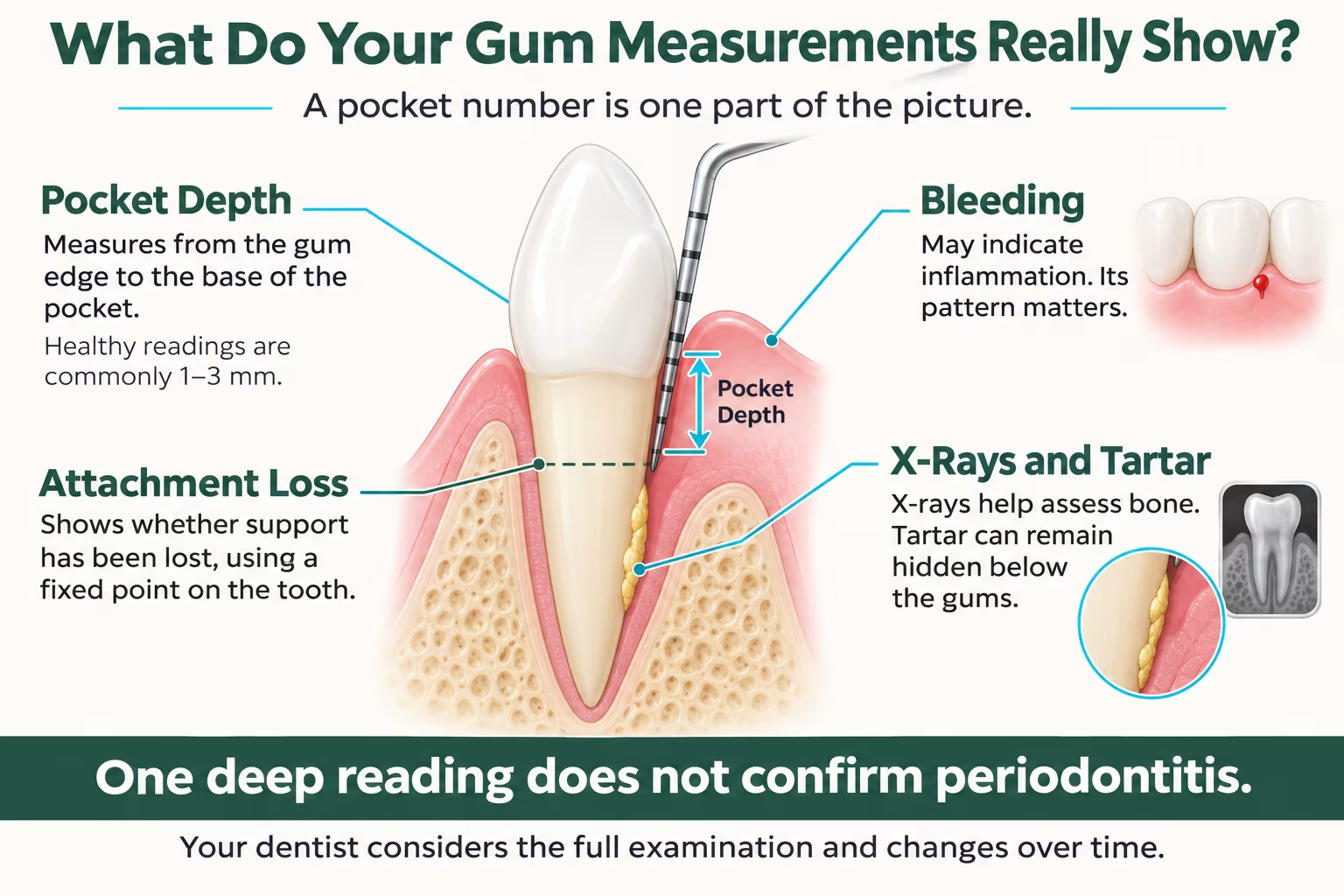
A periodontal chart records findings around each tooth. The pattern often tells us more than the largest number. Measurements can be taken at six sites around each tooth because the gum support at one side of a molar can differ from another.
Ask which sites prompted concern rather than focusing on one number called across the room.
Pocket Depth: What Do Four, Five, and Six Millimetres Mean?
A periodontal pocket depth measures the space from the gum edge to the base of the pocket. Around healthy teeth, readings are commonly 1 to 3 mm. Deeper readings require context.
A 6 mm pocket deserves attention but is not a diagnosis. Swelling can deepen a reading without the attachment loss seen in periodontitis. Recession also affects interpretation.
Bleeding: Is It One Spot or a Pattern?
Bleeding during gentle probing may indicate inflammation. We consider its pattern alongside pocket depth.
Gingivitis can cause bleeding without attachment loss. Smoking may suppress visible bleeding even when periodontal problems exist.
Attachment Loss: Has the Gum Support Changed?
Clinical attachment loss uses a fixed point on the tooth to assess lost support. It differs from measuring a swollen pocket.
Two patients with 5 mm readings may need different care. One may have swelling; another may have lost supporting tissue.
X-Rays and Tartar: What Can the Eye Miss?
When indicated, bitewing or periapical X-rays may help assess supporting bone. They cannot show every sign of inflammation or replace probing. An image that looks reassuring to you still needs clinical interpretation.
Hardened tartar may also cling to roots below the gumline. Home brushing cannot remove it. Its location helps guide treatment.
Do I Need Scaling and Root Planing if My Gums Bleed?
Possibly. Bleeding alone does not establish periodontitis.
Gingivitis can cause swollen, bleeding gums without loss of attachment. Professional cleaning and improved plaque control may be suitable.
Periodontitis involves lost supporting tissue. Mention recession, persistent bad breath, changed tooth spacing, or looseness, too. None confirms the diagnosis alone.
If a gum disease deep cleaning is proposed, ask whether your chart supports a diagnosis of periodontitis.
Regular Cleaning vs Deep Cleaning: What Changes?
The instruments may look familiar. The treatment objective differs.
|
Question |
Routine Cleaning |
Scaling and Root Planing |
|
Main purpose |
Control plaque and tartar as part of preventive care |
Treat affected root surfaces when periodontitis is diagnosed |
|
Where cleaning occurs |
Accessible tooth surfaces, including around the gum edge |
Below the gumline within affected pockets |
|
What guides treatment |
Routine examination and hygiene needs |
Periodontal charting, attachment findings and imaging when indicated |
|
Comfort measures |
Based on sensitivity and cleaning needs |
Local anaesthetic may be recommended |
|
Follow-up |
Individual preventive recall |
Reassessment and periodontal maintenance as needed |
Each treatment serves a different purpose. Deeper cleaning needs a clinical reason.
Do I Need Scaling and Root Planing for a Deep Pocket?
Not necessarily. A pocket number is only one finding.
Consider these findings, without treating them as diagnoses:
- A 5 mm pocket with swollen gums but no attachment loss: inflammation may explain some of the depth; the dentist must determine appropriate care.
- Several 5 to 6 mm pockets with documented attachment loss: these findings may support periodontal therapy, depending on the complete assessment.
- A previously treated 5 mm pocket without bleeding: this may require monitoring or further assessment rather than automatic repeat treatment.
- Recession with shallow pockets: the tooth can have lost support even though the current probing number appears small.
Past charts help show whether an area is stable or changing.
What Happens During Scaling and Root Planing?
Treatment may focus on selected teeth and be divided across visits.
Removing Deposits Below the Gumline
We remove plaque and tartar from affected roots and smooth surfaces as needed. Local anaesthetic may improve comfort.
This non-surgical care helps control inflammation. Lost gum and bone support do not reliably grow back.
Checking Whether Treatment Worked
At follow-up, we may remeasure pockets, assess bleeding and review plaque control.
Some pockets improve; others remain difficult to maintain. Further non-surgical treatment, maintenance, or an assessment for gum surgery may be appropriate.
What Should You Expect After a Deep Cleaning?
Temporary tenderness, mild bleeding, or cold sensitivity may occur. As swelling settles, roots or spaces between teeth can become more noticeable.
Follow your post-treatment cleaning and eating instructions. Never scrape tartar from your own teeth.
Contact us if symptoms are severe, worsening, or failing to improve as expected. Rapidly spreading swelling, difficulty breathing or swallowing, or uncontrolled bleeding requires emergency medical care.
Can You Wait, Ask Questions, or Get Another Opinion?
Yes. Before consenting, ask about the diagnosis, alternatives, risks, and consequences of waiting. Ontario dental guidance supports informed decisions.
Five useful questions to bring to the chair are:
- Which teeth have pockets that concern you?
- Where does the chart show attachment or bone loss?
- Is the diagnosis gingivitis, periodontitis, or something else?
- What could change if I postpone treatment?
- When will you reassess the areas after treatment?
If periodontitis is present, delaying treatment may allow further support loss without obvious symptoms. Ask how urgent your findings are.
If you seek a second opinion, request your periodontal chart and relevant X-rays so the next clinician can review the same evidence.
Does Your Health History Change the Recommendation?
Yes. Tell your dentist about smoking or vaping, diabetes, previous gum treatment, and medications affecting gum tissues.
Past periodontitis may mean ongoing maintenance even without symptoms. Frequent tartar buildup alone does not establish a need for deep cleaning.
Can CDCP Help With Periodontal Treatment in Guelph?
The Canadian Dental Care Plan may cover eligible scaling and root planing, subject to frequency limits. Extra units may require preauthorization.
Ask for a written treatment breakdown, including the affected areas, and verify your benefits before agreeing. Coverage under CDCP does not necessarily mean you have no out-of-pocket costs.
If extra units need approval, ask what can be confirmed before scheduling.
Scaling and Root Planing in Guelph
At Wellington Dental Clinic, we assess gum health through an examination that may include periodontal measurements, a review of inflammation and recession, and appropriate X-rays.
Depending on the findings, we can discuss routine dental cleaning, scaling and root planing, or further periodontal care.
Frequently Asked Questions
Does a 4 mm gum pocket mean I need a deep cleaning?
No. A 4 mm measurement needs interpretation alongside inflammation, attachment loss, previous treatment, and other findings. It does not automatically justify scaling and root planing.
Do I need scaling and root planing if my gums never bleed?
Possibly. Bleeding can be absent despite periodontal problems, especially in smokers. Your examination and any relevant imaging carry more weight than bleeding alone.
Can gingivitis be treated with a regular cleaning?
Often, yes. Professional cleaning and effective daily plaque removal may improve gingivitis. Your dentist will check whether there is any attachment loss that changes the diagnosis.
Can I have deep cleaning on only one side of my mouth?
Yes. Treatment can focus on affected teeth or sections of the mouth. The extent should match your periodontal findings, rather than automatically include every tooth.
Will scaling and root planing make my gums recede?
As swelling improves, gums can settle and expose areas previously covered by inflamed tissue. Your dentist can explain how this might affect appearance or sensitivity.
Does deep cleaning replace brushing and flossing?
No. Professional treatment removes hardened deposits, while consistent home care helps control plaque between appointments. You may need guidance on interdental brushes or other suitable tools.
Will I need another deep cleaning every year?
Not necessarily. Follow-up findings determine whether further treatment is needed. Some patients instead continue with individualized periodontal maintenance visits.
Are antibiotics needed with scaling and root planing?
Usually, they are not routinely needed. Your dentist will consider whether any additional treatment is appropriate for your diagnosis. Antibiotics cannot remove tartar from root surfaces.
Can lost gum or bone support grow back after treatment?
Scaling and root planing can help control inflammation, but it does not reliably restore lost tissue. Further procedures may be considered for selected cases after assessment.
Can I see my periodontal chart before agreeing?
Yes. Ask your dental team to walk through the measurements, imaging findings, proposed areas for treatment, and follow-up plan. You should be able to make an informed decision.
Know What Your Gum Chart Shows Before Booking
If a cleaning has turned into a recommendation you weren't expecting, bring the pocket numbers into the conversation.
At Wellington Dental Clinic, we can review what they show, explain the options, and discuss whether scaling and root planing fits your needs. Book a gum assessment or call (226) 314-3614.
86 Gordon St Unit-D
Guelph, ON N1H 4H6, Canada