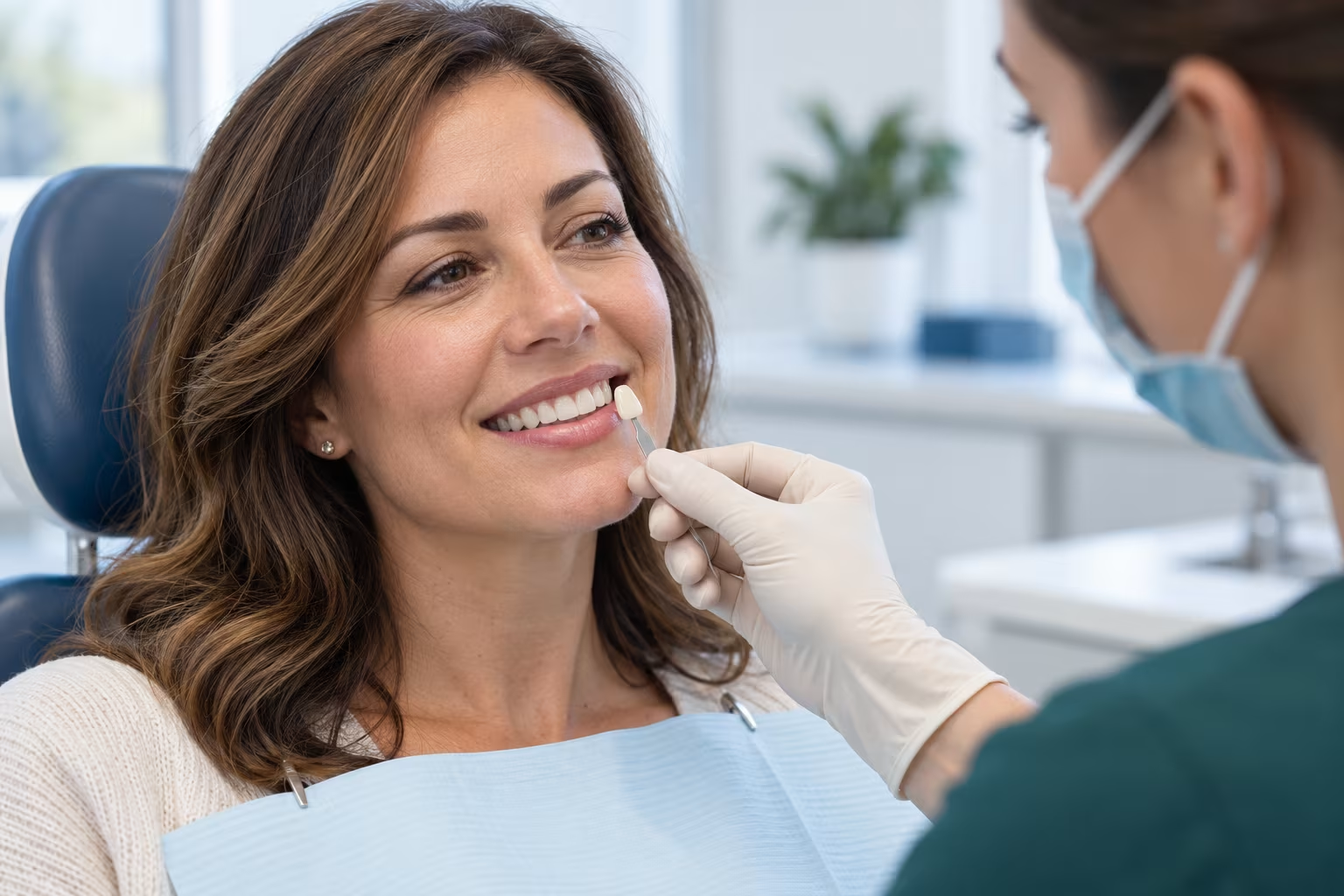

A front-tooth chip that looks small in the mirror can still be awkward to repair well. If it reaches the biting edge, involves an older repair, or leaves a thin strip of enamel, the dentist may have less reliable tooth structure to work with than the chip suggests.
For a minor defect, bonding for a chipped tooth may be enough. A veneer may be considered when more of the visible surface needs to be changed. A crown for a front tooth is generally a more extensive option and may come into the discussion when significantly more tooth structure has been lost.
The difficult part is often the edge between appearance and function. A front tooth has to match the neighbouring teeth in colour and contour, but the repaired area also has to sit in a bite that may place repeated force on the same spot.
A good chipped front tooth repair therefore starts with what is still intact, where the chip ends, and how much sound enamel is available for the repair.
Is a Chipped Front Tooth Only a Cosmetic Problem?
Sometimes the concern is mainly cosmetic. A chip can also be part of a larger dental injury.
A tooth may fracture through enamel alone, extend into dentin, or involve the pulp inside the tooth. Trauma can also affect the root, periodontal tissues, or neighbouring teeth even when those injuries are less obvious than the missing corner you can see.
After a recent accident, tell the dentist:
- What caused the injury
- When it happened
- Whether you found the broken fragment
- Whether the tooth moved or felt loose
- Whether your bite feels different
- Whether there was bleeding from the tooth or gums
- Whether the tooth is sensitive to air, cold, or pressure
- Whether the tooth has changed colour
- Whether you have pain without touching the tooth
- Whether nearby teeth were hit as well
- Whether there was an injury to the lip, jaw, or face
- Whether you lost consciousness or have other symptoms from the accident
Traumatic dental injuries can involve more than the visible fracture. The American Association of Endodontists advises examination after dental trauma because additional injuries can sometimes be found in neighbouring teeth.
A cosmetic restoration may still be appropriate, but first the dentist needs to understand the injury being restored.
What Does a Dentist Check Before Chipped Front Tooth Repair?
The missing piece is only the beginning of the assessment.
For a front tooth, the dentist may look at:
- How much enamel has been lost
- Whether dentin is exposed
- Whether the pulp appears involved
- The depth and direction of the fracture
- Whether the chip reaches the biting edge
- How much enamel remains around the defect
- Whether a fracture line continues beyond the visible chip
- Existing fillings or bonding
- Previous veneers or crowns
- The condition of the remaining tooth
- The colour of the tooth and neighbouring teeth
- Tooth shape and symmetry
- How the upper and lower front teeth meet
- Wear from grinding or clenching
- Whether the tooth moves normally within its socket
- Gum and periodontal findings
- Symptoms following trauma
- Dental X-rays when clinically indicated
- The patient's appearance goals and treatment preferences
These findings can point in different directions.
A small chip surrounded by healthy enamel may offer a good surface for an adhesive repair. A tooth with repeated large repairs, limited enamel, a substantial fracture, or other structural concerns may need a different approach.
When Is Bonding for a Chipped Tooth Considered?
Bonding is commonly used for smaller repairs.
The Canadian Dental Association describes bonding as a treatment in which tooth-coloured composite resin is applied, shaped, hardened, and polished. The material can be shaped to replace the missing portion of a chipped tooth.
Bonding is applied to a smaller portion of the tooth than a veneer, which covers the front surface.
That can make bonding useful when the goal is to replace a missing corner without covering more of an otherwise healthy tooth.
When Might a Veneer for a Chipped Tooth Be Discussed?
A veneer covers the front surface of the tooth rather than replacing only a small missing area.
Both porcelain and composite resin veneers can be used in dentistry. The CDA notes that veneers may change tooth colour, shape, angle, or spacing and can be used for chipped or broken teeth.
A veneer for a chipped tooth may enter the discussion when:
- More of the visible front surface needs correction
- The chip is accompanied by another cosmetic concern
- Existing discolouration affects the treatment goal
- Previous repairs have changed the shape or appearance of the tooth
- Direct bonding may not provide the desired contour
- There is adequate suitable enamel for veneer bonding
- The bite is compatible with the proposed restoration
- The tooth and surrounding gums are healthy enough for elective veneer treatment
Enamel availability deserves close attention here.
The CDA advises that a tooth with very little enamel may not be a suitable veneer candidate because the veneer needs an appropriate bonding surface. If too much tooth structure is missing, a crown may be considered instead.
A veneer also involves treatment of more of the visible tooth surface than a localized bonded repair.
That difference should be part of the discussion when the original chip is relatively small.
When Might a Crown for a Front Tooth Be Considered?
A crown covers the prepared visible portion of a tooth more extensively.
For that reason, a crown is generally considered when the structural problem goes beyond a small cosmetic defect.
A crown for a front tooth may be discussed when there is:
- Substantial loss of natural tooth structure
- A large existing restoration
- Repeated previous restorative treatment
- A significant fracture
- Structural weakness that requires broader coverage
- Too little suitable structure for a veneer
- Root canal treatment with restorative needs that favour a crown
- A combination of structural and appearance concerns
- Another clinical finding that makes a more conservative restoration less suitable
The CDA identifies broken teeth, teeth with large fillings, and some teeth after root canal treatment among situations in which crowns may be used.
A crown also requires preparation of the tooth to create room for the restoration.
For a healthy front tooth with a very small chip, that difference in tooth preparation deserves consideration before choosing a crown solely because it can cover the defect.
How Do Bonding, Veneers, and Crowns Compare?
They differ in how much of the tooth they restore and what they require from the remaining tooth.
|
Treatment |
What it generally restores |
Tooth structure considerations |
Appearance considerations |
Functional considerations |
|
Bonding |
A localized chip or missing area |
Usually relies heavily on the existing tooth as the foundation for a direct composite repair |
Composite can be selected and shaped to blend with neighbouring teeth |
Edge location and bite contacts can affect the repair |
|
Veneer |
More of the visible front surface |
Adequate suitable enamel is important for bonding, and some tooth preparation may be required |
Can address colour, contour, shape, and a chip together |
Bruxism and bite forces can affect suitability |
|
Crown |
Most or all of the visible prepared tooth |
Used when broader coverage is considered appropriate for a more substantially damaged tooth |
Shape, colour, fit, and relationship with neighbouring teeth are planned |
Bite, remaining structure, and overall tooth condition influence the recommendation |
There is overlap between these categories.
A tooth that could technically accept a larger restoration may still be better suited to a smaller one. A tooth that looks suitable for bonding from a photograph may have findings that become evident only after examination.
The choice depends on the actual tooth.
Is a Veneer or Crown More Durable Than Bonding?
There is no useful durability ranking that applies to every chipped front tooth.
Material properties differ, but the condition of the tooth and the way the restoration is loaded are central to the outcome.
A small bonded edge on a favourable tooth is a very different restoration from a large composite repair replacing substantial missing structure.
The same applies to veneers and crowns.
Factors that can affect maintenance include:
? Amount of tooth remaining
? Quality of the bonding surface
? Size and location of the restoration
? Bite forces
? Grinding or clenching
? Oral hygiene
? Diet and habits
? Trauma
? Restoration material
? Existing dental work
? Changes to the tooth over time
No restoration should be presented as permanent or guaranteed.
A patient choosing among bonding, a veneer, and a crown should understand what future maintenance may involve as well as what the restoration looks like when first placed.
How Quickly Should a Chipped Front Tooth Be Checked?
It depends on what happened and how the tooth feels.
A tiny chip without pain or trauma may not require the same urgency as a large fracture after a fall or sports injury.
The CDA advises contacting a dentist for a chipped or broken tooth, and the AAE recommends examination following traumatic dental injury because the type and severity of injury influence treatment.
Difficulty breathing or swallowing, rapidly spreading facial or neck swelling, uncontrolled bleeding, serious facial trauma, loss of consciousness, or other potentially life-threatening symptoms require emergency medical assessment.
Chipped Front Tooth Repair in Guelph
For a chipped front tooth, we can examine the injury and discuss which restorative or cosmetic options fit the condition of the tooth.
Wellington Dental Clinic offers dental bonding, veneers, dental crown restoration, and broader cosmetic dentistry in Guelph. The clinic also provides emergency dental care for broken and injured teeth. Same-day appointments may be available depending on urgency and the clinic schedule.
For bonding specifically, our current service information describes evaluating natural tooth colour under natural and clinical lighting and using multiple resin shades when appropriate to reproduce depth and translucency. The exact technique still depends on the individual tooth and repair.
Wellington Dental Clinic
86 Gordon St Unit-D
Guelph, ON N1H 4H6
Canada
Phone: (226) 314-3614
Email: smile@wellingtondentalguelph.ca
What Else Do Patients Ask About Chipped Front Tooth Repair?
Can a small chipped front tooth be bonded?
Often, depending on the fracture and remaining tooth. Composite bonding is commonly used to restore smaller chipped areas. The dentist still needs to examine the tooth, particularly when the chip followed an injury.
Is bonding for a chipped tooth permanent?
No restoration should be considered permanent.
Composite can wear, stain, chip, or require additional polishing or repair over time. Its maintenance depends on the size and location of the repair, bite forces, habits, and the condition of the tooth.
Is a veneer better than bonding for a chipped front tooth?
It depends on what needs to be restored.
Bonding repairs a smaller portion of the tooth, while a veneer covers the front surface. A veneer may be discussed when more of the visible surface requires a change, provided there is suitable tooth structure for it.
How do I know if I need a crown instead of bonding?
The amount and quality of remaining tooth structure are important. A crown may be considered when a tooth has substantially more structural damage, a large existing restoration, significant fracture, or another condition requiring broader coverage. A small chip alone does not establish that a crown is needed.
Does a chipped tooth need an X-ray?
Sometimes. An X-ray may be recommended when the injury, symptoms, fracture depth, or clinical findings suggest that information about the root, bone, or surrounding structures would be useful.
Should I whiten my teeth before repairing a chipped front tooth?
That depends on your cosmetic plan. Whitening changes natural tooth colour, while existing composite, veneers, and crowns do not lighten in the same way. If you are considering whitening as well as a front-tooth restoration, discuss the treatment sequence before the final restoration shade is selected.
Want the Chipped Tooth Assessed?
If you need chipped front tooth repair in Guelph, contact us to have the tooth examined before deciding between bonding, a veneer, a crown, or another appropriate treatment.
For a recent injury, significant pain, or a larger fracture, call (226) 314-3614 and describe what happened so we can help determine the appropriate timing for your visit. You can also book online for available appointments.
Wellington Dental Clinic
86 Gordon St Unit-D
Guelph, ON N1H 4H6
Canada
Phone: (226) 314-3614
Email: smile@wellingtondentalguelph.ca
This article provides general educational information and is not a diagnosis or a replacement for professional dental or medical advice. The appropriate treatment for a chipped or injured tooth depends on an individual examination and diagnosis. Seek emergency medical care for difficulty breathing or swallowing, rapidly spreading facial or neck swelling, uncontrolled bleeding, serious facial trauma, loss of consciousness, or other life-threatening symptoms.