
For Blog #2, the strongest approach is a 2026 CDCP patient guide specifically for Guelph. I’ve based the eligibility, coverage and co-payment details on current Government of Canada information, since CDCP rules can change.
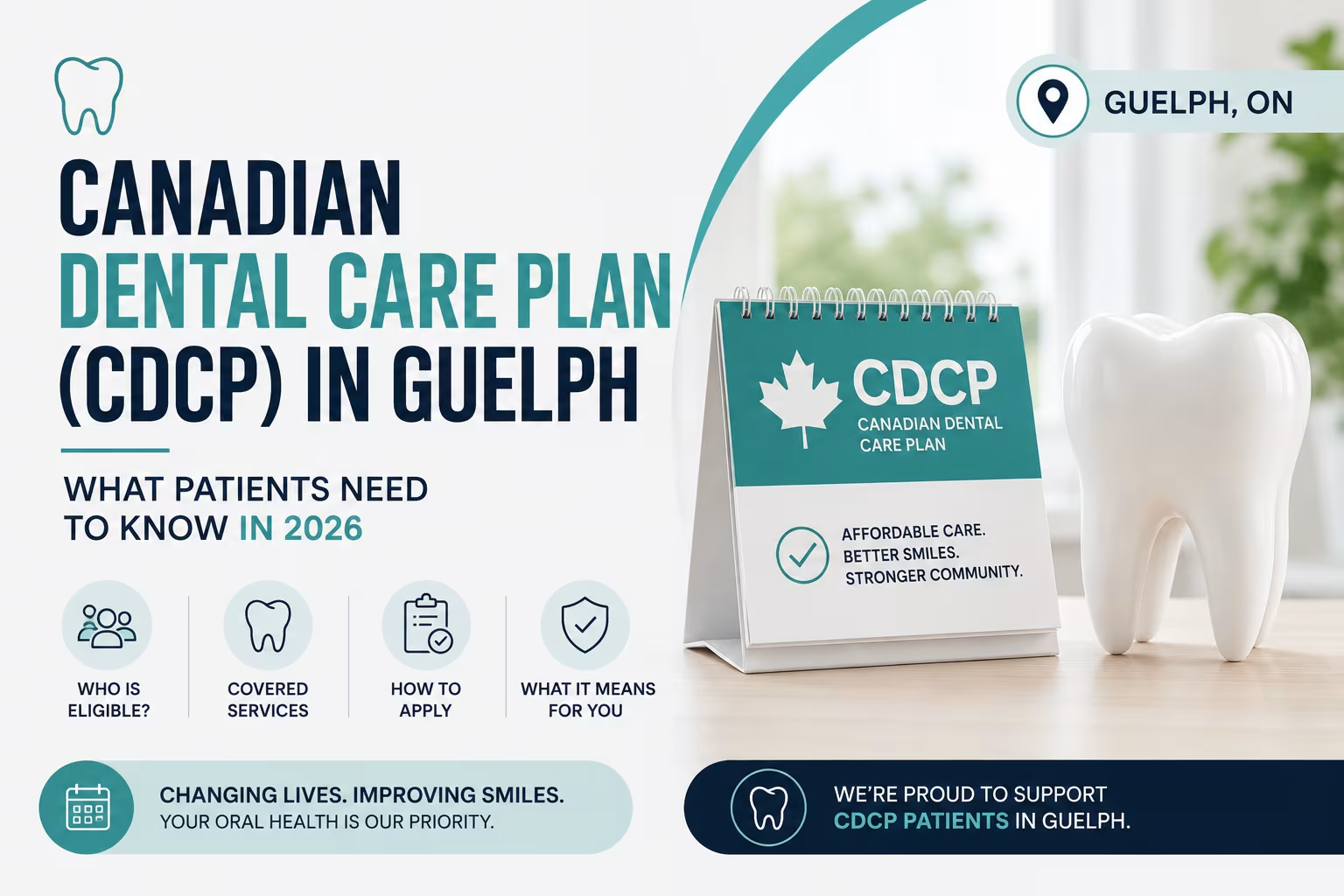
Canadian Dental Care Plan (CDCP) in Guelph: What Patients Need to Know in 2026
Slug:canadian-dental-care-plan-cdcp-guelph
Meta Description:
Looking for a CDCP dentist in Guelph? Learn about Canadian Dental Care Plan eligibility, covered dental services, co-payments, appointments, and what patients should know before visiting a dentist.
Keywords:
CDCP dentist Guelph, Canadian Dental Care Plan Guelph, dentist accepting CDCP Guelph, CDCP dental clinic Guelph, CDCP coverage Guelph, Canadian dental plan Guelph, affordable dentist Guelph, dental care plan Ontario, CDCP dental coverage, CDCP dental services, CDCP dental cleaning Guelph, CDCP fillings Guelph, CDCP dentures Guelph, CDCP root canal Guelph, family dentist Guelph, dentist downtown Guelph, Wellington Dental Clinic Guelph
For many Canadians, the cost of dental treatment can make it difficult to receive regular preventive care or address dental problems before they become more serious.
The Canadian Dental Care Plan (CDCP) is a federal program designed to help make oral health care more affordable for eligible Canadian residents who do not have access to private dental insurance.
If you live in Guelph and have been approved for the CDCP, you may be wondering:
What dental services are covered?
Does CDCP mean my dental treatment is free?
How much will I have to pay?
How do I use my CDCP coverage at a dentist in Guelph?
Understanding how the program works before your appointment can help you make informed decisions about your dental care.
This guide explains the Canadian Dental Care Plan, eligibility requirements, potential coverage, co-payments, and what Guelph patients should know before booking a dental appointment.
What Is the Canadian Dental Care Plan (CDCP)?
The Canadian Dental Care Plan is a federally administered dental benefit intended to reduce financial barriers to oral health care for eligible Canadian residents.
The program helps cover a portion of the cost of eligible oral health services.
It is important to understand that the CDCP is not the same as having completely free dental care.
The amount covered depends on factors including:
- Your eligibility
- Your adjusted family net income
- The dental service being provided
- CDCP coverage rules
- CDCP-established fees
- Whether preauthorization is required
- The fee charged by your dental provider
Depending on your circumstances, you may still have an amount to pay directly to your dental provider.
Who Is Eligible for the Canadian Dental Care Plan?
According to the Government of Canada, you must meet all four eligibility requirements to qualify for the CDCP.
1. You Must Not Have Access to Private Dental Insurance
Generally, you cannot have access to private dental insurance or dental coverage through sources such as:
- Your employer
- A family member's employer
- A pension plan
- A family member's pension plan
- A professional or student organization
- Privately purchased dental insurance
Access to certain health spending accounts that include dental coverage can also affect eligibility.
Having access to dental benefits through a provincial, territorial, or federal government social program does not necessarily make you ineligible. In some cases, coverage may be coordinated between programs.
2. You Must Have Filed Your Canadian Tax Return
You and your spouse or common-law partner, when applicable, must have filed the required Canadian tax returns so the government can assess your family income.
3. Your Adjusted Family Net Income Must Be Under $90,000
CDCP eligibility currently requires an adjusted family net income below $90,000.
Your income also affects the percentage of CDCP-established fees that the plan may cover.
4. You Must Be a Canadian Resident for Tax Purposes
Applicants must meet the program's Canadian residency requirements for tax purposes.
Because eligibility rules can change, patients should always confirm their current eligibility through the official Government of Canada CDCP information before relying on coverage.
Is the Canadian Dental Care Plan Available in Guelph?
Yes.
The CDCP is a federal program available to eligible Canadian residents, including qualifying residents of Guelph, Ontario.
However, having CDCP coverage does not automatically mean that every dental office will provide treatment through the program.
Before booking an appointment, patients should confirm that their chosen dental provider accepts CDCP patients and can bill Sun Life directly for eligible CDCP services.
Does Wellington Dental Clinic Accept CDCP Patients?
If you are looking for dental care through the Canadian Dental Care Plan in Guelph, you can contact Wellington Dental Clinic to discuss your CDCP coverage and appointment availability.
Our clinic is conveniently located in downtown Guelph:
Wellington Dental Clinic
86 Gordon St Unit-D
Guelph, ON N1H 4H6
Canada
When contacting the clinic, let the dental team know that you have CDCP coverage so your eligibility and relevant coverage information can be reviewed before treatment.
What Dental Services Can the CDCP Cover?
The Canadian Dental Care Plan covers a range of eligible oral health services, subject to the plan's conditions, frequency limits, authorization requirements, and established fees.
Depending on your individual needs and eligibility, covered categories can include certain:
Diagnostic Services
These may include eligible services used to assess your oral health, such as:
- Dental examinations
- Specific dental X-rays
- Other eligible diagnostic procedures
Dental examinations help your dentist identify concerns such as cavities, gum disease, damaged teeth, infections, and other oral health conditions.
Preventive Dental Services
Eligible preventive services may include certain:
- Dental scaling
- Polishing
- Fluoride treatments
- Sealants
Preventive care can help reduce the risk of tooth decay and gum disease and allows dental problems to be identified earlier.
Restorative Dental Services
Certain restorative treatments may be eligible for coverage, including services such as:
- Dental fillings
- Some restorative procedures
The exact treatment recommended depends on the condition of the tooth and your individual oral health needs.
Endodontic Services
Certain endodontic procedures, including eligible root canal treatments, may be covered under CDCP rules.
Root canal treatment may be recommended when the pulp inside a tooth becomes infected or significantly damaged.
Periodontal Services
The CDCP can cover certain services used to treat the gums and supporting structures around teeth.
Depending on clinical need and plan rules, this can include eligible periodontal treatments.
Oral Surgery Services
Certain oral surgery procedures may qualify for CDCP coverage.
These can include eligible tooth extractions and other surgical dental procedures when clinically required.
Prosthodontic Services
Certain denture-related services may also be eligible under the plan, subject to CDCP requirements.
Because coverage varies by treatment and individual circumstances, patients should not assume that a particular procedure is automatically covered.
Your dental provider can review the proposed treatment and available CDCP benefits before proceeding.
Does CDCP Cover Dental Cleanings?
Certain preventive dental services, including eligible scaling procedures, can be covered by the Canadian Dental Care Plan.
However, CDCP coverage is subject to plan-specific frequency limits and policies.
The amount covered may also depend on your adjusted family net income and the provider's fees.
For this reason, it is helpful to confirm your available benefits before receiving treatment.
Does CDCP Cover Dental Fillings?
Certain dental fillings are included within eligible restorative services under the CDCP.
Your dentist first needs to examine the tooth and determine whether a filling is clinically appropriate.
Coverage can depend on the specific tooth, restoration required, CDCP policies, frequency limitations, and other factors.
Does CDCP Cover Root Canal Treatment?
Certain root canal treatments may be eligible under the Canadian Dental Care Plan.
A root canal may be recommended when the dental pulp becomes infected, inflamed, or significantly damaged.
Your dentist will assess the affected tooth and determine whether root canal treatment, another restorative approach, or extraction is appropriate.
Coverage should be verified before treatment.
Does CDCP Cover Tooth Extractions?
Certain tooth extractions and oral surgery procedures may be covered under the CDCP when they meet program requirements.
Before extraction, your dentist will normally assess the tooth and surrounding tissues and may take dental X-rays.
Whenever appropriate, available treatment options can then be discussed with you.
Does CDCP Cover Dentures?
The Canadian Dental Care Plan includes certain prosthodontic services, which can include eligible denture-related treatment.
However, coverage conditions and authorization requirements can apply.
If you need complete dentures, partial dentures, repairs, relines, or other denture-related treatment, ask your dental provider to confirm your specific CDCP coverage before beginning treatment.
Does CDCP Make Dental Treatment Completely Free?
Not necessarily.
This is one of the most important things for CDCP patients to understand.
The CDCP reimburses dental providers according to CDCP-established fees, and patients may be responsible for part of the cost.
There are two major reasons you may have an out-of-pocket amount:
- Your income level requires a CDCP co-payment.
- Your dental provider's fee is higher than the amount reimbursed under the CDCP fee structure.
You may also be responsible for services that are not covered by the CDCP.
How Do CDCP Co-Payments Work?
Your co-payment is based on your adjusted family net income.
Under the current CDCP structure:
Adjusted Family Net Income Below $70,000
The CDCP may cover 100% of eligible service costs at CDCP-established fees.
This does not necessarily mean the patient will pay $0.
If the dental provider's fee is higher than the amount reimbursed by CDCP, the patient may still be responsible for the difference.
Adjusted Family Net Income Between $70,000 and $79,999
The CDCP may cover 60% of eligible costs at CDCP-established fees.
The patient is responsible for a 40% co-payment of the CDCP-established fee, plus any applicable additional charges.
Adjusted Family Net Income Between $80,000 and $89,999
The CDCP may cover 40% of eligible costs at CDCP-established fees.
The patient is responsible for a 60% co-payment, plus any applicable additional charges.
These percentages are based on the CDCP fee schedule rather than necessarily the dental clinic's regular treatment fee.
Why Might I Still Have to Pay If CDCP Covers 100%?
This can initially be confusing.
Suppose the CDCP covers 100% of its established fee for an eligible procedure.
If your dental provider's usual fee for that procedure is higher than the CDCP-established fee, there may still be a difference that you are responsible for paying.
You may also have costs associated with treatments or services that are not eligible under the CDCP.
Therefore:
100% CDCP coverage does not always mean $0 out-of-pocket dental treatment.
Before treatment begins, ask your dental provider about estimated costs and any portion that may not be covered.
What Is Preauthorization?
Some dental treatments may require preauthorization before the CDCP will cover them.
Preauthorization means that information about the proposed treatment is submitted for review before treatment proceeds.
Depending on the procedure, supporting information may be required, such as:
- Dental X-rays
- Treatment plans
- Clinical findings
- Other supporting documentation
The purpose is to determine whether the proposed service meets the CDCP's coverage criteria.
Approval of one treatment also does not automatically mean every related procedure will be covered.
Your dental provider can explain when preauthorization is required.
How Do I Apply for the Canadian Dental Care Plan?
Applications for the 2026–2027 CDCP benefit year are currently open.
Eligible residents can apply through the Government of Canada's official Canadian Dental Care Plan application process.
Information that may be required includes:
- Full name
- Date of birth
- Social Insurance Number, when applicable
- Home and mailing address
- Information about government dental benefits, if applicable
- Tax information
You and your spouse or common-law partner, when applicable, must have filed the required Canadian tax returns and received your Notice of Assessment.
Patients should use official Government of Canada channels when applying and be cautious about websites or individuals requesting unnecessary personal or financial information.
I've Been Approved for CDCP. What Should I Do Next?
Approval does not mean you should immediately receive treatment without first checking your coverage.
Once approved, review your CDCP documentation carefully.
Your information should identify your:
- CDCP member information
- Coverage start date
- Current eligibility
- Applicable co-payment level
You can only use CDCP benefits for eligible treatment received on or after your coverage start date.
Before booking an appointment, confirm that your coverage is currently active.
What Should I Tell the Dental Clinic When Booking?
When contacting a dental clinic in Guelph, tell the receptionist that you are covered under the Canadian Dental Care Plan.
It is helpful to have your relevant CDCP information available.
The dental office may need information to:
- Confirm your eligibility
- Verify that your coverage is active
- Review applicable co-payments
- Check whether a proposed service is covered
- Determine whether preauthorization is necessary
- Prepare an estimate when appropriate
This can help reduce unexpected costs and confusion at your appointment.
What Should I Bring to My CDCP Dental Appointment?
Consider bringing:
- Government-issued identification
- Your CDCP information or correspondence
- Your CDCP member ID
- Relevant medical information
- A current list of medications
- Information about other government dental benefits, when applicable
- Details about your dental concern
If this is your first visit to the clinic, you may also be asked to complete medical and dental history forms.
How Does CDCP Billing Work?
For eligible services provided through the CDCP, participating oral health providers submit claims directly to Sun Life, which administers CDCP claims.
Patients should generally not pay the entire treatment cost upfront with the expectation that Sun Life will reimburse them later.
Under the CDCP, reimbursement for covered services is made to the oral health provider rather than directly to the patient.
The patient is responsible for applicable co-payments and other amounts that are not covered.
Do I Need to Renew My CDCP Coverage?
Yes.
CDCP coverage is not automatically permanent.
Members must continue to meet eligibility requirements and renew or re-establish coverage as required for each benefit period.
For the current 2026–2027 benefit year, coverage runs from July 1, 2026 through June 30, 2027 for eligible members.
Patients who had 2025–2026 coverage but missed the 2026 renewal deadline can submit a new application, although there may be a gap in coverage.
Dental services received during a gap in CDCP coverage are not covered retroactively.
Because dates and renewal procedures can change, always check the latest Government of Canada information.
Can Children Receive Dental Care Through CDCP?
Children who meet the applicable eligibility requirements can receive coverage through the Canadian Dental Care Plan.
Eligible services can include preventive, diagnostic, and restorative dental treatment according to CDCP policies.
Regular dental visits during childhood can help dentists monitor tooth development, identify cavities, assess oral hygiene, and address problems before they become more complicated.
Parents should verify each child's active CDCP coverage before appointments.
Can Seniors Use the Canadian Dental Care Plan?
Eligible seniors can receive dental coverage through the CDCP if they meet the program requirements.
Depending on individual oral health needs and plan coverage, services may include examinations, preventive treatment, restorative care, periodontal treatment, extractions, and certain denture-related procedures.
Because older adults can have complex dental and medical needs, your dentist should also be informed about medications and relevant medical conditions before treatment.
Can I Use CDCP If I Have Ontario Government Dental Benefits?
Having dental coverage through certain provincial, territorial, or federal government social programs does not automatically prevent someone from qualifying for the CDCP.
When a person qualifies for multiple government dental programs, benefits may be coordinated according to applicable rules.
Patients receiving dental support through another government program should disclose that information when applying for CDCP and when visiting their dental provider.
What If I Need Dental Treatment That CDCP Doesn't Cover?
The Canadian Dental Care Plan does not cover every possible dental procedure.
If your dentist recommends treatment that is not covered—or is only partially covered—you should receive an explanation of your treatment options and estimated financial responsibility before proceeding.
You can then make an informed decision based on:
- Your oral health needs
- Treatment alternatives
- Expected benefits
- Potential risks
- CDCP coverage
- Estimated out-of-pocket cost
Never assume a treatment is fully covered simply because you are enrolled in CDCP.
Finding a CDCP Dentist in Guelph
If you have CDCP coverage and are looking for a dentist in Guelph, consider asking the dental clinic several questions before your first appointment:
- Are you currently accepting CDCP patients?
- Will you bill Sun Life directly?
- Can you verify my active CDCP coverage?
- Will I have a co-payment?
- Could there be additional fees?
- Does my proposed treatment require preauthorization?
- Can I receive an estimate before treatment?
Asking these questions can help you better understand both your dental treatment and financial responsibility.
CDCP Dental Care at Wellington Dental Clinic in Guelph
Wellington Dental Clinic provides dental care from our downtown Guelph location:
Wellington Dental Clinic
86 Gordon St Unit-D
Guelph, ON N1H 4H6
Canada
Patients can contact the clinic to discuss Canadian Dental Care Plan appointments, current acceptance of CDCP patients, eligibility verification, and available dental services.
Our dental services include preventive, general, restorative, emergency, and surgical dental care based on individual patient needs.
If you have already received your CDCP approval, have your member information available when contacting the clinic.
Frequently Asked Questions About CDCP in Guelph
What is the Canadian Dental Care Plan?
The Canadian Dental Care Plan is a federal program that helps reduce the cost of eligible oral health services for qualifying Canadian residents who do not have access to private dental insurance.
Who qualifies for CDCP in 2026?
Current requirements include having no access to private dental insurance or coverage, having filed the required Canadian tax return, having an adjusted family net income below $90,000, and being a Canadian resident for tax purposes. Applicants must meet all eligibility requirements.
Is CDCP available to Guelph residents?
Yes. Eligible residents of Guelph, Ontario can participate in the federal Canadian Dental Care Plan.
Is dental treatment completely free with CDCP?
Not necessarily. Depending on your adjusted family net income, you may have a co-payment. You may also be responsible for differences between your provider's fee and CDCP-established fees, as well as services that are not covered.
Does CDCP cover dental cleanings?
Certain eligible preventive services, including scaling, may be covered subject to CDCP rules, frequency limitations, and individual eligibility.
Does CDCP cover fillings?
Certain restorative procedures, including eligible dental fillings, can be covered according to CDCP policies.
Does CDCP cover root canals?
Certain endodontic treatments, including eligible root canal procedures, may be covered. Coverage should be confirmed for your specific treatment.
Does CDCP cover tooth extraction?
Certain eligible tooth extractions and oral surgery procedures are included under CDCP coverage, subject to plan requirements.
Does CDCP cover dentures?
Certain denture-related and prosthodontic services may qualify for coverage. Some treatments may require preauthorization.
Can I pay my dentist and get reimbursed by CDCP?
Generally, no. Under the CDCP, Sun Life reimburses participating oral health providers for covered services. Patients should not pay the full amount expecting reimbursement from Sun Life.
How do I know how much CDCP will pay?
Your dental provider can verify your active coverage and may submit an estimate or preauthorization request when appropriate. Your coverage depends on your co-payment level, the service, CDCP rules, and CDCP-established fees.
Do I need to renew CDCP every year?
Yes. CDCP members need to continue meeting eligibility requirements and renew their coverage according to the federal program's requirements.
Looking for a CDCP Dentist in Guelph?
Understanding dental coverage should not be more complicated than the dental treatment itself.
If you have been approved for the Canadian Dental Care Plan and are looking for dental care in Guelph, contact Wellington Dental Clinic to discuss your coverage and appointment options.
Wellington Dental Clinic
86 Gordon St Unit-D, Guelph, ON N1H 4H6, Canada
Before your appointment, have your CDCP member information available so the dental team can review your coverage and explain any expected out-of-pocket costs.
Taking advantage of eligible preventive and restorative dental care can help you address oral health problems earlier and maintain a healthier smile.
CDCP eligibility, covered services, fees, co-payments, preauthorization requirements, and benefit periods are determined by the Government of Canada and may change. This article provides general educational information and does not guarantee eligibility or coverage. Patients should confirm current information through the Government of Canada and their dental provider before treatment.
End of Article